

If you’re young, active, and you’ve developed a nagging pinch of groin pain, the kind that flares with deep squats, pivoting, or sitting low in a car seat, take note. Femoroacetabular impingement (FAI) is one of the most common, and most overlooked, culprits. It’s especially common in footballers, hockey players, and dancers. It’s often written off as a “tight hip flexor” for months before anyone joins the dots.
What Is Femoroacetabular Impingement?
FAI describes a structural mismatch between the ball (femoral head) and socket (acetabulum) of the hip. Extra bone on one or both sides causes them to jam against each other during hip movement, particularly deep flexion. There are two recognised shapes. Cam morphology is where the femoral head isn’t perfectly round, and it’s more common in young, athletic men. Pincer morphology is where the socket has extra coverage over the femoral head, and it’s more common in middle-aged women. Many people have a mix of both. Repeated impingement can gradually damage the labrum, the cartilage rim of the socket, and the surrounding joint cartilage.
The Three Types of FAI
FAI isn’t one single shape problem. It’s classified into three types based on where the extra bone forms and how it creates contact between the femur and the socket.
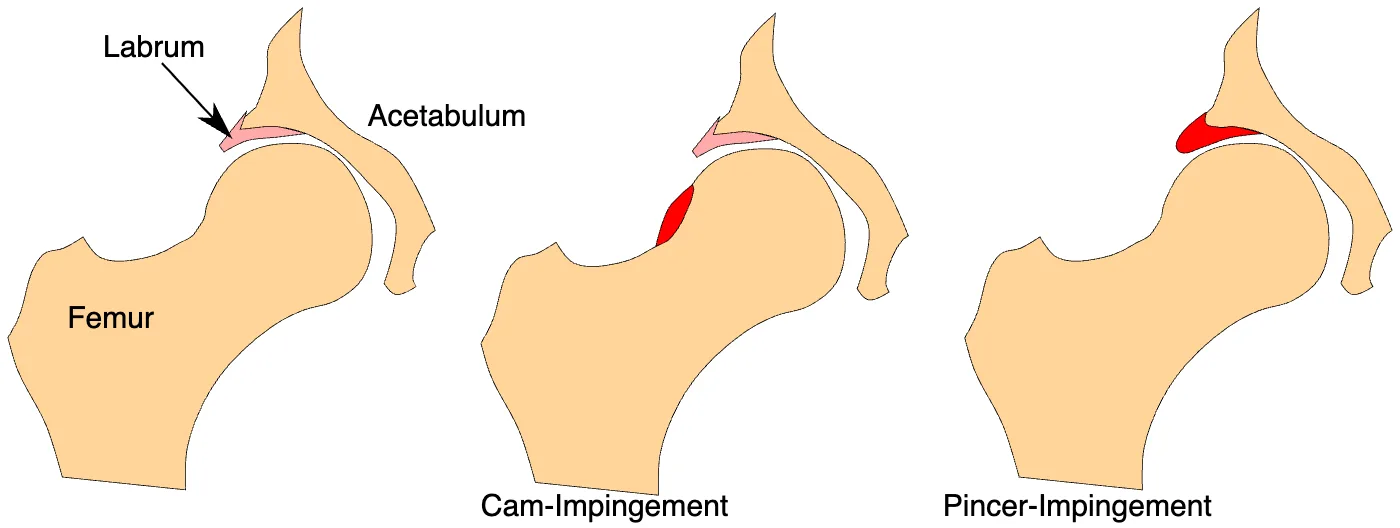
Cam-type and pincer-type FAI compared to normal hip anatomy. Diagram by Takuma-sa and Hellerhoff, Wikimedia Commons, licensed under CC BY-SA 4.0.
Cam-type FAI happens when the femoral head isn’t perfectly round. Extra bone forms at the head-neck junction, creating a bump that jams into the socket during hip flexion and internal rotation. That’s the exact position reached at the bottom of a deep squat.
Pincer-type FAI happens when the acetabulum covers the femoral head more than it should, whether from a naturally deep socket or an abnormally angled rim. This extra coverage means the socket edge repeatedly contacts the femoral neck before the hip reaches full range.
Mixed-type FAI combines both cam and pincer features on the same hip. It’s actually the most common presentation seen clinically, not either pure type on its own.
According to PubMed, three distinct types of FAI have been described: cam-type, pincer-type, and mixed. Recognising which morphology is present matters because it shapes both diagnosis and treatment (Peeters et al., 2009). Imaging research also shows the prevalence of each type differs across populations. Mixed-type impingement is significantly more common in athletes than in people without symptoms (Mascarenhas et al., 2015).
Who Gets It, and Why
FAI is strongly linked to sport. There is growing evidence that intense training during adolescence, particularly in football, hockey, and dance, increases the risk of the cam shape developing in the first place. This is likely from repetitive loading on the growing hip joint. That said, plenty of people have cam or pincer morphology on imaging and never develop symptoms. Having the bony shape isn’t the same as having the syndrome. Symptoms tend to emerge when the joint is loaded repeatedly at end-range hip flexion and rotation. Think deep squats, cutting and pivoting sports, or activities with a large range of hip motion like dance and martial arts.
How It Feels
The classic complaint is a slow-building, aching or sharp groin pain. It’s often described with the “C-sign”: cupping the hand over the front and side of the hip. It’s commonly worse with prolonged sitting, getting in and out of a car, deep squatting, or twisting movements. Some people also notice clicking or a sense of catching in the joint. On examination, the classic finding is pain reproduced by the FADIR test. This brings the hip into flexion, adduction, and internal rotation, which pinches the impinged tissue between the femur and the socket.
Getting a Proper Diagnosis
Groin pain has so many possible causes. Adductor-related groin pain, hip flexor strain, and deep gluteal syndrome can all mimic it. That’s why FAI is a clinical diagnosis first and an imaging diagnosis second. Your physio or doctor will typically combine your history and movement tests, like the FADIR test, with plain X-rays to look at the shape of the femoral head and socket. Sometimes an MRI is added to check the labrum and cartilage directly. It’s worth remembering that a cam or pincer shape on a scan doesn’t automatically explain your pain. Plenty of pain-free people have the same bony shape. The diagnosis only really holds when the story, the exam, and the imaging all line up together.
Do You Need Surgery?
This is where the evidence gets genuinely interesting. One systematic review of trials compared hip arthroscopy with structured physiotherapy. Three out of four studies favoured surgery in the short term, suggesting arthroscopy can offer a faster or larger improvement in pain and function for some people. But “favoured” isn’t the same as “essential.” The same body of evidence shows structured physiotherapy still produces real, meaningful improvement on its own. Surgery carries its own costs, risks, and recovery time that physiotherapy doesn’t. A well-designed, physiotherapist-led exercise program remains a reasonable, evidence-supported first step for mild-to-moderate FAI, particularly before committing to surgery. A meaningful proportion of people improve enough that they never need it.
How Physio Can Help
The best-studied non-surgical approach comes from the FASHIoN trial, a large multi-centre randomised controlled trial that developed and tested a structured program called Personalised Hip Therapy. It isn’t a generic exercise handout. It’s built around four components: a detailed individual assessment, education about the condition and what’s safe to load, help managing pain and irritability in the short term, and a progressive, individually tailored, supervised exercise program. This is typically delivered across 12 to 26 weeks, over six to ten sessions with a musculoskeletal physiotherapist.
That exercise component typically targets hip and pelvic control: deep hip and glute strengthening, and movement retraining for how you load the hip during squats, lunges, and sport-specific movements. It also includes a gradual, graded return to the positions that provoke your symptoms as your tolerance improves. Hip flexor and iliopsoas control is often part of the picture too. It directly influences how the femoral head sits in the socket during hip flexion.
When to Book In
If groin pain is holding back your training, your squat depth, or just getting comfortable in a low chair, don’t wait for it to “settle on its own.” Book online with the team at Praxis and we’ll assess whether FAI is driving your symptoms and build an evidence-based plan around it.
Until next time, Praxis What You Preach
📍 Clinics in Teneriffe, Buranda, and Carseldine
💪 Trusted by athletes. Backed by evidence. Here for everyone.
Related Articles
Deep Gluteal Syndrome: The Buttock Pain That Mimics Sciatica
Sciatica: Why That Shooting Leg Pain Isn't the Life Sentence It Feels Like
Why Your Glutes Aren't Lazy, They're Underdeveloped
References
- Fortier, L. M., Popovsky, D., Durci, M. M., Norwood, H., Sherman, W. F., & Kaye, A. D. (2022). An updated review of femoroacetabular impingement syndrome. Orthopedic Reviews, 14(3), 37513. https://doi.org/10.52965/001c.37513
- Anzillotti, G., Iacomella, A., Grancagnolo, M., Bertolino, E. M., Marcacci, M., Sconza, C., Kon, E., & Di Matteo, B. (2022). Conservative vs. surgical management for femoro-acetabular impingement: A systematic review of clinical evidence. Journal of Clinical Medicine, 11(19), 5852. https://doi.org/10.3390/jcm11195852
- Zhu, Y., Su, P., Xu, T., Zhang, L., & Fu, W. (2022). Conservative therapy versus arthroscopic surgery of femoroacetabular impingement syndrome (FAI): A systematic review and meta-analysis. Journal of Orthopaedic Surgery and Research, 17(1), 296. https://doi.org/10.1186/s13018-022-03187-1
- Wall, P. D. H., Dickenson, E. J., Robinson, D., Hughes, I., Realpe, A., Hobson, R., Griffin, D. R., & Foster, N. E. (2016). Personalised Hip Therapy: Development of a non-operative protocol to treat femoroacetabular impingement syndrome in the FASHIoN randomised controlled trial. British Journal of Sports Medicine, 50(19), 1217-1223. https://doi.org/10.1136/bjsports-2016-096368
- Lawrenson, P. R., French, H. P., Olivier, B., Barker, K. L., Kemp, J. L., Whittaker, J. L., & Woodley, S. J. (2025). Diagnosis and management of femoroacetabular impingement syndrome (FAIS): A survey of contemporary physiotherapy practice. BMC Musculoskeletal Disorders, 26, 924. https://doi.org/10.1186/s12891-025-08708-7
- Peeters, J., Vanhoenacker, F. M., Marchal, P., Mulkens, T., Ghysen, D., Myncke, J., Van Dyck, P., Gielen, J. L., Termote, J. L., & Parizel, P. M. (2009). Imaging of femoroacetabular impingement: Pictorial review. JBR-BTR, 92(1), 35-42. https://pubmed.ncbi.nlm.nih.gov/19358486/
- Mascarenhas, V. V., Rego, P., Dantas, P., Morais, F., McWilliams, J., Collado, D., Marques, H., Gaspar, A., Soldado, F., & Consciencia, J. G. (2015). Imaging prevalence of femoroacetabular impingement in symptomatic patients, athletes, and asymptomatic individuals: A systematic review. European Journal of Radiology, 85(1), 73-95. https://doi.org/10.1016/j.ejrad.2015.10.016