
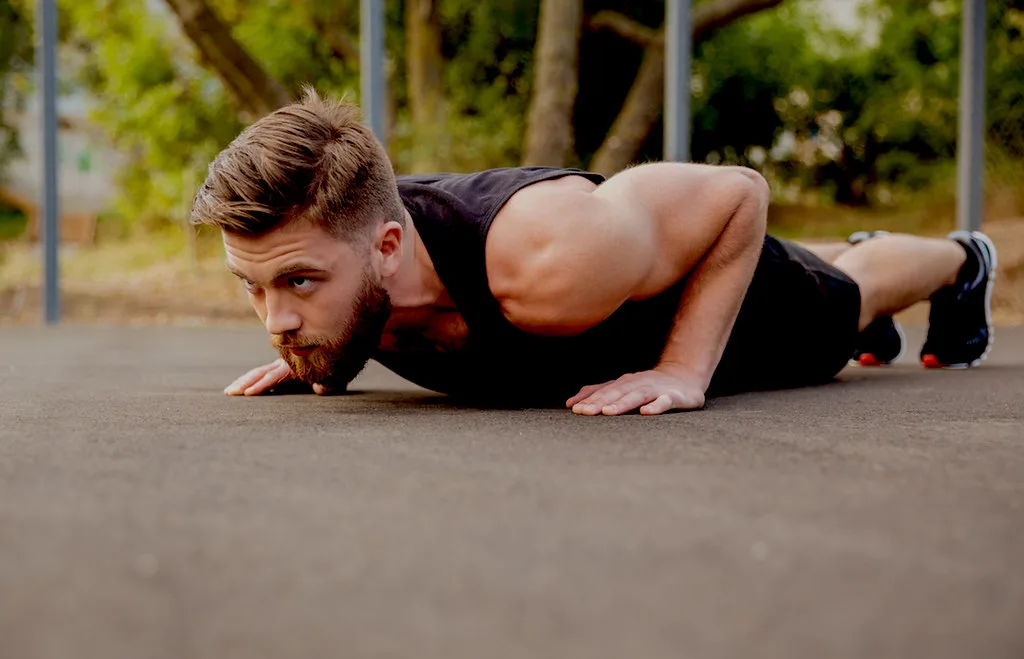
Shoulder rehab tends to focus heavily on range of motion and pain. Both matter, but neither tells you whether a shoulder can actually take the repeated, high-load demands of throwing, tackling, or pushing off the ground in contact sport. The Closed Kinetic Chain Upper Extremity Stability Test, usually shortened to CKCUEST, is one of the few shoulder tests with solid evidence behind it as a return-to-sport measure.
WHAT THE TEST ACTUALLY MEASURES
The test is performed in a push-up position, hands on the floor a set distance apart. The athlete repeatedly reaches one hand across to touch the opposite hand and back, alternating sides, for 15 seconds. The number of touches is counted and compared side to side. Because the hands stay planted on the ground throughout, the shoulder has to stabilise under load while the trunk and opposite arm move around it. That mimics the demands placed on the shoulder during contact, tackling, and load-bearing sport far better than a simple range-of-motion or isolated strength test.
A 2014 reliability study by Tucci and colleagues, published in BMC Musculoskeletal Disorders, tested the CKCUEST in 108 people with and without shoulder impingement syndrome. It proved to be a reliable measure across both groups, with people who had shoulder pain scoring consistently lower than those without. The test has since been shown to correlate with grip strength and with isokinetic shoulder rotator strength, both established markers of shoulder capacity.
WHY TESTING BEATS GUESSING
Shoulder return-to-sport decisions are often made once pain has settled and range of motion has returned, without a load-bearing capacity test being part of the picture at all. That’s a gap. Pain resolution and true stability under load are not the same thing, and the CKCUEST is specifically designed to expose that gap before an athlete finds out the hard way in a match.
The broader principle here is consistent with return-to-sport research from other joints: a 2016 Delaware-Oslo cohort study by Grindem and colleagues found that athletes cleared using objective discharge testing, rather than pain and time alone, had an 84% lower rate of reinjury after ACL reconstruction. A related study by Kyritsis and colleagues found a fourfold increase in reinjury risk in those who didn’t meet full discharge criteria. Neither study is shoulder-specific, but the same logic applies directly: an objective, load-based test catches deficits that subjective readiness does not.
THE KINETIC CHAIN COST OF CUTTING CORNERS
A shoulder that returns to contact or overhead sport under-stabilised doesn’t just risk re-injuring itself. Athletes commonly compensate for shoulder instability by altering trunk and scapular mechanics. That can transfer load into the neck, the opposite shoulder, and the elbow over a season of repeated throwing or tackling. This same adjacent-site pattern is well documented after lower limb injury too. A 2016 systematic review by Wiggins and colleagues found that athletes returning to sport after ACL reconstruction had a roughly even split between reinjuring the same knee and the opposite knee. This illustrates how an under-tested joint tends to push the injury risk sideways through the kinetic chain rather than removing it.
Recurrent shoulder instability also has a well-established compounding effect. Each dislocation or subluxation tends to make the next one more likely, and chronic instability is a recognised pathway toward earlier degenerative change in the joint. A capacity test that catches inadequate stability before return to sport is one of the more practical ways to interrupt that cycle.
WHAT WE DO AT PRAXIS
We use the CKCUEST alongside rotator cuff strength testing and sport-specific loading progressions before clearing athletes back to contact, throwing, or overhead sport after shoulder injury or surgery. If you’re returning from a shoulder injury, dislocation, or rotator cuff repair, book a return-to-sport assessment with our team.
Until next time, Praxis What You Preach…
📍 Clinics in Teneriffe, Woolloongabba, and Carseldine
💪 Trusted by athletes. Backed by evidence. Here for everyone.
Related Articles
Rotator Cuff Repair: A Physiotherapy Guide on Recovery and Rehabilitation
Shoulder Stabilisation and Bankart Repair: Your Path Back to Sport
Return to Sport Testing: The Complete Guide
References
Tucci HT, Martins J, Sposito GC, Camarini PMF, de Oliveira AS. Closed Kinetic Chain Upper Extremity Stability test (CKCUES test): a reliability study in persons with and without shoulder impingement syndrome. BMC Musculoskeletal Disorders. 2014;15:1.
Grindem H, Snyder-Mackler L, Moksnes H, Engebretsen L, Risberg MA. Simple decision rules can reduce reinjury risk by 84% after anterior cruciate ligament reconstruction: the Delaware-Oslo ACL cohort study. British Journal of Sports Medicine. 2016;50(13):804-808.
Kyritsis P, Bahr R, Landreau P, Miladi R, Witvrouw E. Likelihood of ACL graft rupture: not meeting six clinical discharge criteria before return to sport is associated with a four times greater risk of rupture. British Journal of Sports Medicine. 2016;50(15):946-951.
Wiggins AJ, Grandhi RK, Schneider DK, Stanfield D, Webster KE, Myer GD. Risk of secondary injury in younger athletes after anterior cruciate ligament reconstruction: a systematic review and meta-analysis. American Journal of Sports Medicine. 2016;44(7):1861-1876.