
There’s a particular kind of dread that sets in when you feel a twinge sprinting for a ball, or a sharp pull deep in your groin cutting back on the footy field. You know instantly it’s not “just a niggle.” A hamstring or adductor strain has a way of sidelining athletes – weekend warriors and semi-professionals alike – for anywhere from two to twelve weeks, and it has an irritating habit of coming back for round two if the rehab isn’t done properly.
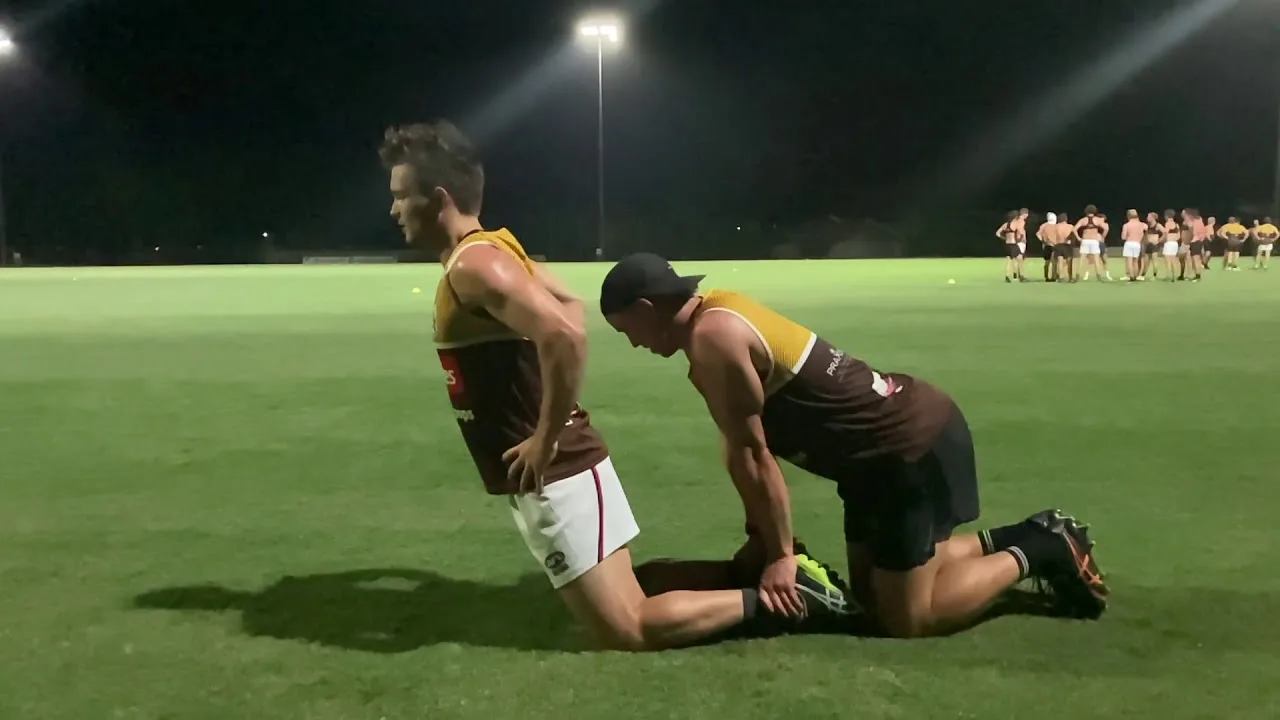
The good news is that a huge amount of research has gone into working out how to stop these injuries before they happen. Two unglamorous, slightly uncomfortable exercises keep coming out on top: the Nordic hamstring curl and the Copenhagen plank. Neither requires fancy equipment. Both have solid evidence behind them. And both are exercises we prescribe regularly here at Praxis for footballers, runners, netballers, and anyone whose sport involves sprinting, kicking, or rapid change of direction.
If you’ve read our piece on hamstring strain injuries and the latest research, you’ll know how frustrating and recurrence-prone these injuries can be. This post is about the flip side – prevention.
WHY THESE TWO EXERCISES?
Hamstring strains and groin/adductor strains are consistently among the most common injuries in field and court sports, and they share a common thread: both muscle groups are asked to produce huge eccentric (lengthening) forces at high speed – the hamstrings decelerating the leg at the end of a sprint stride, the adductors controlling hip abduction during cutting, kicking, and change of direction. Ryan, DeBurca, and Mc Creesh (2014) identified reduced hip adduction strength and previous injury as consistent risk factors for groin and hip injuries in field sports, which is exactly why targeted eccentric strengthening – rather than generic core or gym work – has become the focus of prevention research.
The Nordic hamstring curl trains the hamstrings eccentrically in a lengthened position, closely mimicking the demands of late-swing-phase sprinting. The Copenhagen plank does the same job for the adductors, loading them through a long lever in a side-plank position. Both are simple, both are brutal the first few sessions, and both have research behind them that most gym exercises simply don’t.
THE EVIDENCE FOR NORDIC CURLS
This is where the evidence gets genuinely compelling. Petersen et al. (2011) ran a cluster-randomised controlled trial across 50 Danish soccer teams and found that a progressive Nordic curl programme significantly reduced the rate of both new and recurrent acute hamstring injuries compared with teams doing standard training alone.
That finding has since been confirmed at a much larger scale. Al Attar et al. (2017), in a systematic review and meta-analysis, found that injury prevention programmes including the Nordic hamstring exercise reduced hamstring injury rates by around 51% compared with teams using no such programme. Then van Dyk, Behan, and Whiteley (2019) pooled data from over 8,000 athletes across multiple sports and confirmed an injury rate ratio of roughly 0.49 – essentially, teams doing Nordic curls consistently were about half as likely to suffer a hamstring strain.
There’s also a mechanistic explanation for why it works. Cuthbert et al. (2020) showed that Nordic curl training reliably increases fascicle length in the biceps femoris (the hamstring muscle most commonly injured), meaning the muscle can tolerate greater lengthening at speed before it’s strained – exactly the adaptation you’d want for a sprinting athlete.
WHAT ABOUT THE COPENHAGEN PLANK?
The Copenhagen plank is the adductor equivalent, and the research trail here follows a similar pattern. Ishoi et al. (2016), in a randomised controlled trial with football players, found that an eight-week progressive Copenhagen adduction programme produced large increases in eccentric hip adduction strength – in the order of 9-36% – a strength quality that’s directly linked to groin injury risk.
More importantly, Haroy et al. (2019) tested a Copenhagen-plank-based “Adductor Strengthening Programme” in a cluster-randomised controlled trial across men’s football teams and found it reduced the prevalence of groin problems by roughly 41% over a season. That’s a real-world, injury-outcome level of evidence – not just a strength-testing study.
If you’ve dealt with lingering groin pain before, our article on chronic groin pain and athletic pubalgia covers what happens when adductor-related pain becomes a persistent problem rather than a one-off strain – prevention really is the better option. And for our fast-bowling readers, the same principle of building lengthened-position eccentric capacity applies to the trunk, which is exactly what we discuss in understanding the “side strain” in cricket fast bowlers.
BUSTING THE MYTH: “THESE ARE JUST FOR ELITE FOOTBALLERS”
A common reason these exercises don’t make it into club or weekend-sport training is the assumption they’re only relevant at the professional level. Ironically, Bahr, Thorborg, and Ekstrand (2015) found that even among Champions League and Norwegian Premier League clubs – the exact population the Nordic curl research was built on – only around 11% of teams had fully implemented the protocol, largely due to discomfort, muscle soreness in early weeks, and poor buy-in. If elite clubs with full-time medical staff struggle with compliance, it’s not because the exercise is “too advanced” for amateurs – it’s because dosing and coaching matter, and soreness is manageable with a sensible progression. The upside – roughly halving your hamstring injury risk (van Dyk et al., 2019) – applies to any athlete doing repeated sprinting or change of direction, not just professionals.
HOW TO PROGRAM THEM SAFELY
Both exercises reward patience over bravado. Start with partial-range, assisted Nordic curls (2 sets of 3-5 reps) and low-rep Copenhagen planks (holding from the knee rather than full extension) for the first one to two weeks – expect some genuine delayed-onset soreness early on, which settles quickly with consistent, gradual loading (Cuthbert et al., 2020). From there, progress volume and range over 6-10 weeks toward full-range Nordics and full Copenhagen planks, aiming for two to three sessions a week during pre-season and one maintenance session weekly in-season – mirroring the dosing used in the trials above.
For a visual guide, our physiotherapists have demonstrated the Nordic curl (listed as “Nordic / Hamstring Lower”) on our YouTube channel, @praxisphysiotherapy – well worth a watch before you try it for the first time. The Copenhagen plank is also demonstrated on our YouTube channel, @praxisphysiotherapy.
THE TAKEAWAY
The Nordic hamstring curl and the Copenhagen plank aren’t glamorous, and they’re not comfortable – especially in the first fortnight – but they’re two of the best-evidenced injury prevention exercises in sports medicine. Done consistently and progressed sensibly, they can meaningfully cut your risk of the kind of hamstring or groin strain that ends a season, not just a game.
If you want a strength program tailored to your sport, position, and current niggles rather than a generic YouTube routine, book in with one of our physiotherapists at Praxis. We’ll assess your strength and movement, build a progression that suits your training load, and help you stay on the park.
Until next time, Praxis What You Preach…
📍 Clinics in Teneriffe, Woolloongabba, and Carseldine
💪 Trusted by athletes. Backed by evidence. Here for everyone.
Related Articles
Hamstring Strain Injuries: Lessons from Personal Experience and the Latest Research

'Old Man Calf': Why Calf Tears Become So Common After 30
Why Your Glutes Aren't Lazy, They're Underdeveloped
Al Attar, W.S.A., Soomro, N., Sinclair, P.J., Pappas, E., & Sanders, R.H. (2017). Effect of Injury Prevention Programs that Include the Nordic Hamstring Exercise on Hamstring Injury Rates in Soccer Players: A Systematic Review and Meta-Analysis. Sports Medicine, 47(5), 907-916.
Bahr, R., Thorborg, K., & Ekstrand, J. (2015). Evidence-based hamstring injury prevention is not adopted by the majority of Champions League or Norwegian Premier League football teams: the Nordic Hamstring survey. British Journal of Sports Medicine, 49(22), 1466-1471.
Cuthbert, M., Ripley, N., McMahon, J.J., Evans, M., Haff, G.G., & Comfort, P. (2020). The Effect of Nordic Hamstring Exercise Intervention Volume on Eccentric Strength and Muscle Architecture Adaptations: A Systematic Review and Meta-analyses. Sports Medicine, 50(1), 83-99.
Haroy, J., Clarsen, B., Wiger, E.G., Oyen, M.G., Serner, A., Thorborg, K., Holmich, P., Andersen, T.E., & Bahr, R. (2019). The Adductor Strengthening Programme prevents groin problems among male football players: a cluster-randomised controlled trial. British Journal of Sports Medicine, 53(3), 145-152.
Ishoi, L., Sorensen, C.N., Kaae, N.M., Jorgensen, L.B., Holmich, P., & Serner, A. (2016). Large eccentric strength increase using the Copenhagen Adduction exercise in football: A randomized controlled trial. Scandinavian Journal of Medicine & Science in Sports, 26(11), 1334-1342.
Petersen, J., Thorborg, K., Nielsen, M.B., Budtz-Jorgensen, E., & Holmich, P. (2011). Preventive Effect of Eccentric Training on Acute Hamstring Injuries in Men’s Soccer: A Cluster-Randomized Controlled Trial. American Journal of Sports Medicine, 39(11), 2296-2303.
Ryan, J., DeBurca, N., & Mc Creesh, K. (2014). Risk factors for groin/hip injuries in field-based sports: a systematic review. British Journal of Sports Medicine, 48(14), 1089-1096.
van Dyk, N., Behan, F.P., & Whiteley, R. (2019). Including the Nordic hamstring exercise in injury prevention programmes halves the rate of hamstring injuries: a systematic review and meta-analysis of 8459 athletes. British Journal of Sports Medicine, 53(21), 1362-1370.