
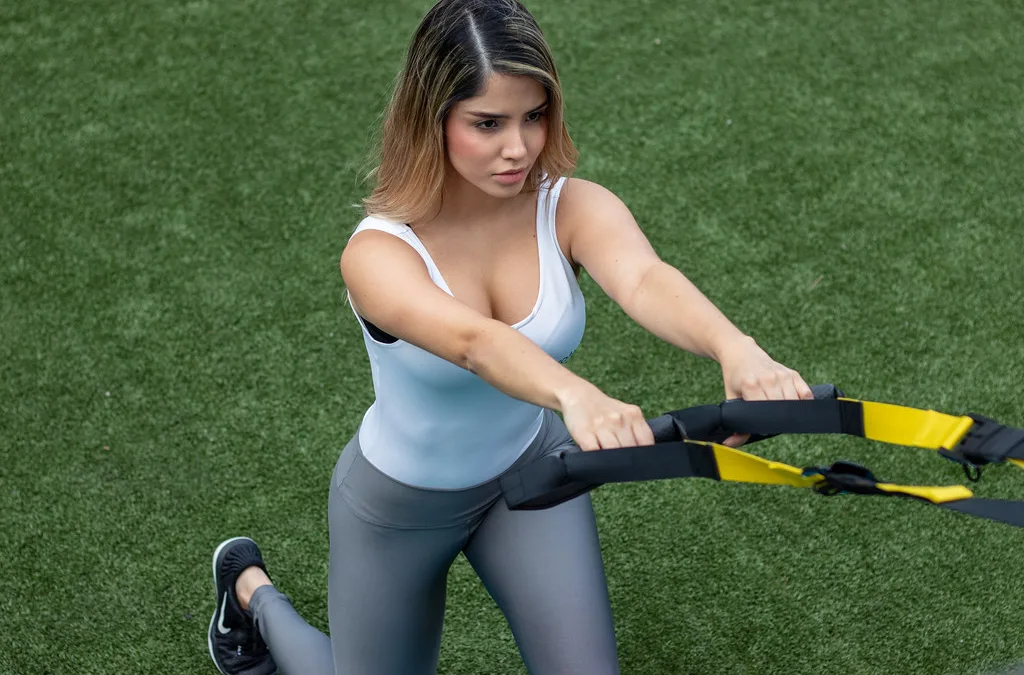
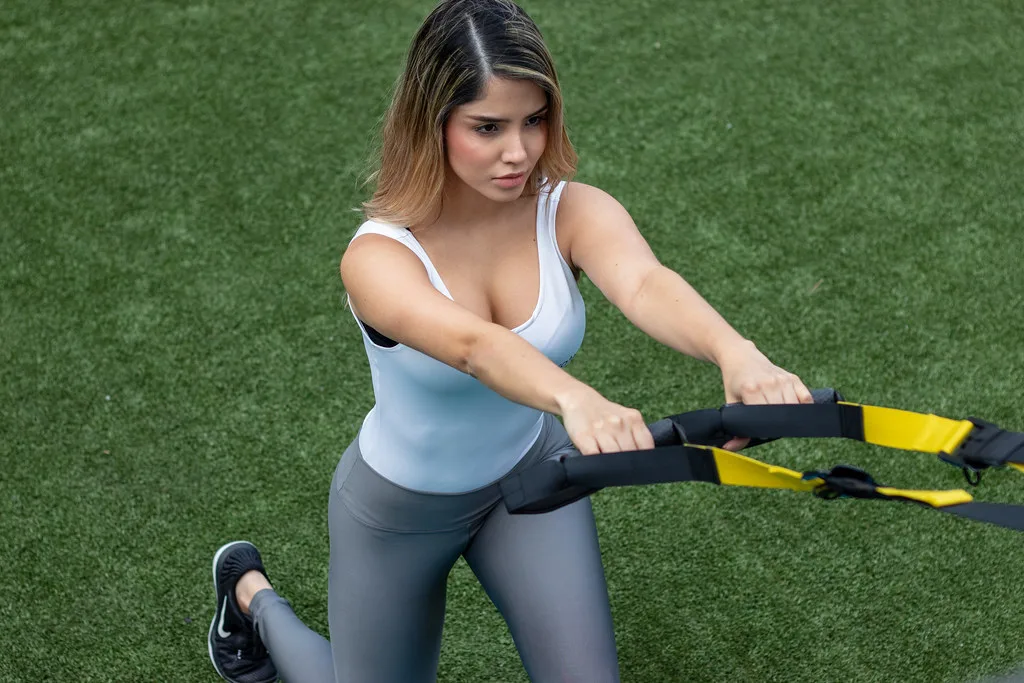
Hip and gluteal control rarely gets tested properly before return to sport, largely because it’s easy to mistake for something else. An athlete with poor hip control can usually still run in a straight line without pain. That’s exactly why the deficit tends to only show up later, in a knee, a groin, or the same hip again, once the demands of cutting and landing expose what straight-line running never did. The single-leg squat and step-down tests are two of the simplest, best-evidenced ways to catch that gap early.
WHAT THE TEST ACTUALLY MEASURES
Both tests are performed standing on one leg, either squatting down as far as controlled technique allows, or stepping down from a small box or step. What’s being assessed isn’t just how deep the movement goes, but the quality of control through it. Does the knee track over the foot or collapse inward? Does the pelvis stay level or drop on the unsupported side? Does the whole movement look stable or wobbly? These patterns are driven largely by hip abductor and external rotator strength, particularly gluteus medius, which is why the test is as much a hip test as it is a knee test.
A 2011 study by Poulsen and James, published in Physiotherapy Theory and Practice, examined the reliability and validity of clinical evaluation of the single-leg squat and found it to be a reliable, valid way for clinicians to assess lower limb control, even when scored visually rather than with laboratory equipment. That’s a meaningful finding, because it means this test doesn’t require expensive gear to be clinically useful, just a trained eye and a consistent scoring approach.
WHY TESTING BEATS GUESSING
Hip control deficits are easy to miss because they often don’t cause pain in the hip itself. An athlete can walk, jog, and even sprint in a straight line with poor gluteal control and feel completely normal, right up until a cutting or landing task demands single-leg stability under load. Without a specific test for this, it simply doesn’t get picked up before return to sport.
This mirrors the broader return-to-sport literature: a 2016 Delaware-Oslo cohort study by Grindem and colleagues found an 84% lower reinjury rate in athletes cleared using objective discharge criteria rather than time alone, and a related study by Kyritsis and colleagues found a fourfold higher reinjury risk in athletes who didn’t meet full discharge criteria. The single-leg squat and step-down tests apply that same principle specifically to the hip and pelvis, an area that’s otherwise very easy to clear on the basis of “no pain” alone.
THE KINETIC CHAIN COST OF CUTTING CORNERS
Poor hip control is one of the clearest examples of a kinetic chain problem in sports medicine, because the knee, not the hip, is usually where the consequences show up. When the pelvis drops and the knee collapses inward during single-leg loading, it changes the angle and force through the knee joint on every step, cut, and landing. That’s a pattern strongly implicated in patellofemoral pain and non-contact ACL injury. The same redistribution effect is well documented after other underprepared joints return to sport. A 2016 systematic review by Wiggins and colleagues found that athletes returning to sport after ACL reconstruction reinjured the same knee and the opposite knee at almost identical rates. That’s a pattern consistent with hip control deficits driving risk into the knee on both sides rather than staying contained at the hip.
Left unaddressed over years of training and competition, this pattern of poor load control through the hip and knee is also implicated in the gradual development of joint degeneration. The joint surfaces end up repeatedly loaded in ways they weren’t designed for. Confirming genuine hip control before returning to full training is one of the more practical ways to interrupt that pattern. It stops the deficit becoming a long-term problem rather than a single injury.
WHAT WE DO AT PRAXIS
We use single-leg squat and step-down assessment alongside gluteal strength testing and landing mechanics screening. Together, these confirm the hip is genuinely controlling load before we clear an athlete back to cutting, jumping, or contact sport. If you’re recovering from a hip, groin, or knee injury, or you simply want to know how your hip control measures up, book a return-to-sport assessment with our team.
Until next time, Praxis What You Preach…
📍 Clinics in Teneriffe, Woolloongabba, and Carseldine
💪 Trusted by athletes. Backed by evidence. Here for everyone.
Related Articles
The Single Leg Squat

Unilateral vs Bilateral Training: Part 1 - Your Comparative Guide
Return to Sport Testing: The Complete Guide
References
Poulsen DR, James CR. Concurrent validity and reliability of clinical evaluation of the single leg squat. Physiotherapy Theory and Practice. 2011;27(8):586-594.
Grindem H, Snyder-Mackler L, Moksnes H, Engebretsen L, Risberg MA. Simple decision rules can reduce reinjury risk by 84% after anterior cruciate ligament reconstruction: the Delaware-Oslo ACL cohort study. British Journal of Sports Medicine. 2016;50(13):804-808.
Kyritsis P, Bahr R, Landreau P, Miladi R, Witvrouw E. Likelihood of ACL graft rupture: not meeting six clinical discharge criteria before return to sport is associated with a four times greater risk of rupture. British Journal of Sports Medicine. 2016;50(15):946-951.
Wiggins AJ, Grandhi RK, Schneider DK, Stanfield D, Webster KE, Myer GD. Risk of secondary injury in younger athletes after anterior cruciate ligament reconstruction: a systematic review and meta-analysis. American Journal of Sports Medicine. 2016;44(7):1861-1876.