
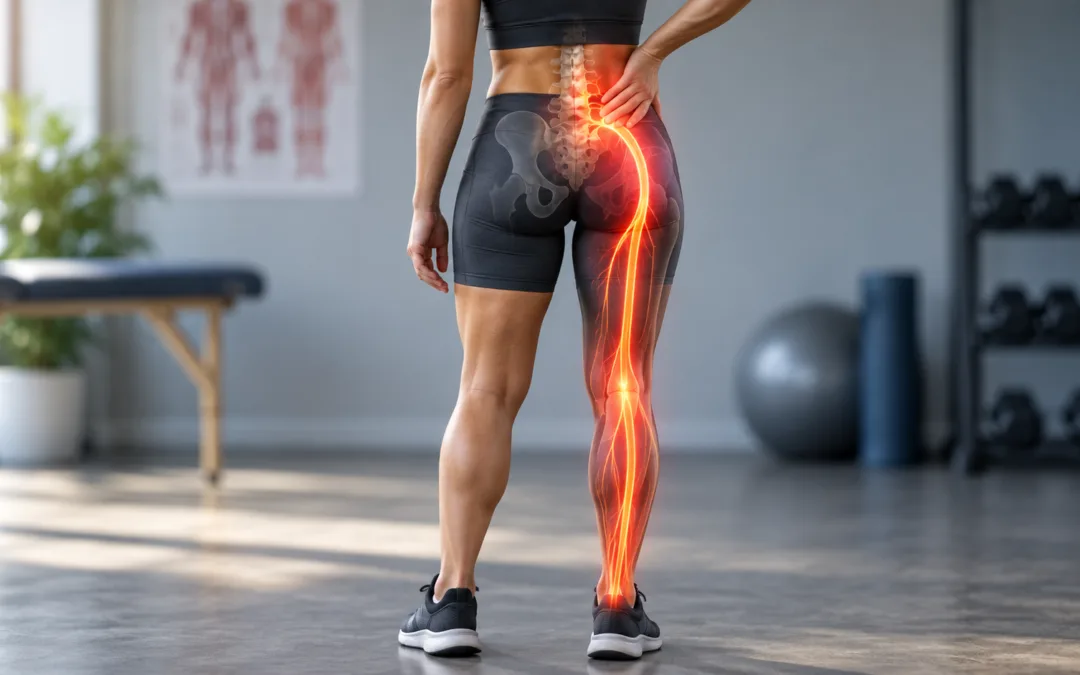
You bend down to pick up a bag of groceries and suddenly there’s a hot, electric line running from your lower back, through your buttock and down the back of your leg. Sometimes it stops at the knee. Sometimes it doesn’t stop until it reaches your foot. Sitting at your desk makes it worse. Getting out of the car has become a slow, careful production. You might have pins and needles down your calf, or a strange numb patch on the sole of your foot that just won’t settle. Sleep is a nightmare!
This is sciatica. If you’re reading this because you’re living through it right now, we want to tell you two things straight away: it is genuinely as unpleasant as it feels, and the overwhelming majority of people recover well without ever needing surgery.
 At Praxis, we see sciatica walk through our Teneriffe, Woolloongabba and Carseldine clinics every single week. It rarely looks the same twice. Some people are gritting their teeth through a full workday, others can barely get out of bed, but the questions are almost always identical. What’s actually causing this? Do I need a scan? Am I going to end up on an operating table? Let’s work through it properly.
WHAT’S ACTUALLY GOING ON?
 “Sciatica” isn’t really a diagnosis. It’s a description of a symptom pattern: pain that travels down the leg, usually below the knee. That pain is caused by irritation or compression of one of the nerve roots that form the sciatic nerve as it exits the spine. The most common culprit is a disc herniation pressing on or chemically irritating a nearby nerve root. Spinal stenosis (narrowing around the nerve) can also produce a similar picture (Peul et al., 2007). The nerve itself doesn’t like being squashed or inflamed, and it lets you know about it. That shows up as the burning, the pins and needles, sometimes the numbness or weakness.
Here’s the genuinely reassuring part: disc herniations are not permanent structural damage that you’re stuck with forever. A 2023 systematic review and meta-analysis found that a large proportion of herniated discs shrink on their own over time, with sequestered and extruded fragments regressing most reliably (Rashed et al., 2023). Your body is, quite literally, built to clean this mess up.
IS BED REST THE ANSWER?
This is probably the single biggest myth we bust in clinic. It feels logical: it hurts, so surely you should stop moving? The evidence says otherwise. A Cochrane systematic review comparing bed rest against staying active for acute low back pain and sciatica found no meaningful difference in pain or function between the two approaches. Prolonged bed rest also carries its own risks, deconditioning, stiffness, low mood, so the sensible advice is to stay as active as your symptoms allow (Dahm et al., 2010). We’ve written more on why waiting it out, or over-resting, can actually leave you worse off in our post on why the wait and see approach may leave you with a poorer outcome.
WHAT ABOUT SCANS AND IMAGING?
“I just need an MRI so we know exactly what’s wrong” is one of the most common requests we hear, and it’s completely understandable. But for most people with sciatica, in the absence of red flags like progressive weakness, loss of bladder or bowel control, or unexplained weight loss, early imaging doesn’t change the treatment plan or improve outcomes. A landmark systematic review and meta-analysis in The Lancet found that routine, immediate lumbar imaging does not improve pain, function, or quality of life compared with usual clinical care guided by a thorough physical assessment (Chou et al., 2009). Scans also frequently pick up disc bulges and degenerative changes in people with zero symptoms, which can create unnecessary alarm rather than clarity. We’ve unpacked this in detail in Fact or Fiction Friday: Lower Back Pain and MRI’s, well worth a read if a scan is on your mind.
WHAT ABOUT MEDICATION?
Physiotherapy addresses the mechanical and neural side of sciatica: movement, strength, and nerve mobility. It doesn’t extend to prescribing. When pain is severe enough to disrupt sleep or stop you engaging with early rehab, a good working relationship with your GP becomes genuinely important, and it’s a part of care that sits outside our scope as physios. According to PubMed, a systematic review of drug trials for sciatica found short courses of corticosteroids produced a modest short-term reduction in leg pain compared with placebo (Pinto et al., 2012). The picture is less encouraging for gabapentin and pregabalin. Despite being commonly prescribed for nerve-related pain, more recent systematic reviews have found little to no meaningful benefit over placebo for pain or disability, alongside a higher rate of side effects (Enke et al., 2018). This is exactly why the GP relationship matters here. Judicious, time-limited medication, guided by someone who’s across the current evidence, can take the edge off pain while your physiotherapy program does the actual rehabilitative work. It isn’t a substitute for that work. We’re always happy to liaise directly with your GP to keep both sides of your care working toward the same plan.
WILL I NEED SURGERY?
Sometimes, but far less often than people assume. A landmark Dutch trial found that early surgery relieved sciatica symptoms roughly twice as fast as prolonged conservative care. Even so, one-year functional outcomes between the two groups ended up much the same (Peul et al., 2007). More recently, a 2020 randomised trial looked at people with sciatica lasting four to twelve months. Surgery did offer faster and somewhat greater pain relief for that specific, more stubborn subgroup, but conservative management still delivered meaningful improvement for many (Bailey et al., 2020). In short: surgery is a legitimate option for a minority of people with severe, persistent, or worsening symptoms. It is not the default pathway for most people with sciatica.
WHAT ACTUALLY WORKS
This is where good physiotherapy earns its keep. A 2023 systematic review and meta-analysis noted the evidence base for specific physiotherapy interventions is still maturing and heterogeneous. Even so, physiotherapy, including graded exercise, education, and a program tailored to your specific presentation, remains recommended as a sensible first-line approach for most people with sciatica (Dove et al., 2023). One technique with growing support is neural mobilisation, sometimes called “nerve gliding” or “nerve flossing”: gentle movements designed to help the irritated nerve move more freely through the surrounding tissue. A 2023 meta-analysis of 20 randomised trials found neural mobilisation meaningfully reduced pain and disability in people with lumbar radiculopathy (Lin et al., 2023). It’s a technique we use regularly in clinic, and it’s about time we filmed a short nerve-glide demonstration video for our YouTube channel so you can see exactly what it looks like.
For a broader look at how we approach the low back more generally, our Lower Back Pain page is a good next stop.
THE TAKEAWAY
Sciatica is miserable to live with, but it is rarely dangerous, rarely permanent, and rarely a surgical emergency. Most people improve with time, staying reasonably active, and a physiotherapy program that addresses your specific movement pattern, strength, and nerve mobility, not with bed rest, and usually not with an early scan either. The goal isn’t just to wait it out and hope; it’s to actively guide your recovery so you get back to your normal life faster and with less risk of it flaring up again. If that shooting leg pain has been part of your daily routine for more than a week or two, come and see us at Praxis in Teneriffe, Woolloongabba, or Carseldine. We’ll assess you properly, rule out anything that needs urgent attention, and build you a plan that gets you moving again.
Until next time, Praxis What You Preach…
📍 Clinics in Teneriffe, Woolloongabba, and Carseldine
💪 Trusted by athletes. Backed by evidence. Here for everyone.
Related Articles
Deep Gluteal Syndrome: The Buttock Pain That Mimics Sciatica

Femoroacetabular Impingement (FAI): The Groin Pain Behind Your Squat and Sitting Trouble
Why Your Glutes Aren't Lazy, They're Underdeveloped
Bailey, C.S., Rasoulinejad, P., Taylor, D., Sequeira, K., Miller, T., Watson, J., Rosedale, R., Bailey, S.I., Gurr, K.R., Siddiqi, F., Glennie, A., & Urquhart, J.C. (2020). Surgery versus conservative care for persistent sciatica lasting 4 to 12 months. New England Journal of Medicine, 382(12), 1093-1102.
Chou, R., Fu, R., Carrino, J.A., & Deyo, R.A. (2009). Imaging strategies for low-back pain: Systematic review and meta-analysis. The Lancet, 373(9662), 463-472.
Dahm, K.T., Brurberg, K.G., Jamtvedt, G., & Hagen, K.B. (2010). Advice to rest in bed versus advice to stay active for acute low-back pain and sciatica. Cochrane Database of Systematic Reviews, Issue 6.
Dove, L., Jordan, J., Chen, Y-F., Foster, N.E., & Konstantinou, K. (2023). How effective are physiotherapy interventions in treating people with sciatica? A systematic review and meta-analysis. European Spine Journal, 32(2), 517-533.
Enke, O., New, H.A., New, C.H., Mathieson, S., McLachlan, A.J., Latimer, J., Maher, C.G., & Lin, C.W. (2018). Anticonvulsants in the treatment of low back pain and lumbar radicular pain: A systematic review and meta-analysis. CMAJ, 190(26), E786-E793.
Lin, L-H., Lin, T-Y., Chang, K-V., Wu, W-T., & Ozcakar, L. (2023). Neural mobilization for reducing pain and disability in patients with lumbar radiculopathy: A systematic review and meta-analysis. Life, 13(12), 2255.
Peul, W.C., van Houwelingen, H.C., van den Hout, W.B., Brand, R., Eekhof, J.A.H., Tans, J.T.J., Thomeer, R.T.W.M., & Koes, B.W. (2007). Surgery versus prolonged conservative treatment for sciatica. New England Journal of Medicine, 356(22), 2245-2256.
Pinto, R.Z., Maher, C.G., Ferreira, M.L., Ferreira, P.H., Hancock, M., Oliveira, V.C., McLachlan, A.J., & Koes, B. (2012). Drugs for relief of pain in patients with sciatica: Systematic review and meta-analysis. BMJ, 344, e497.
Rashed, S.S., Vassiliou, A., Starup-Hansen, J., & Tsang, K. (2023). Systematic review and meta-analysis of predictive factors for spontaneous regression in lumbar disc herniation. Journal of Neurosurgery: Spine, 39(4), 471-483.