
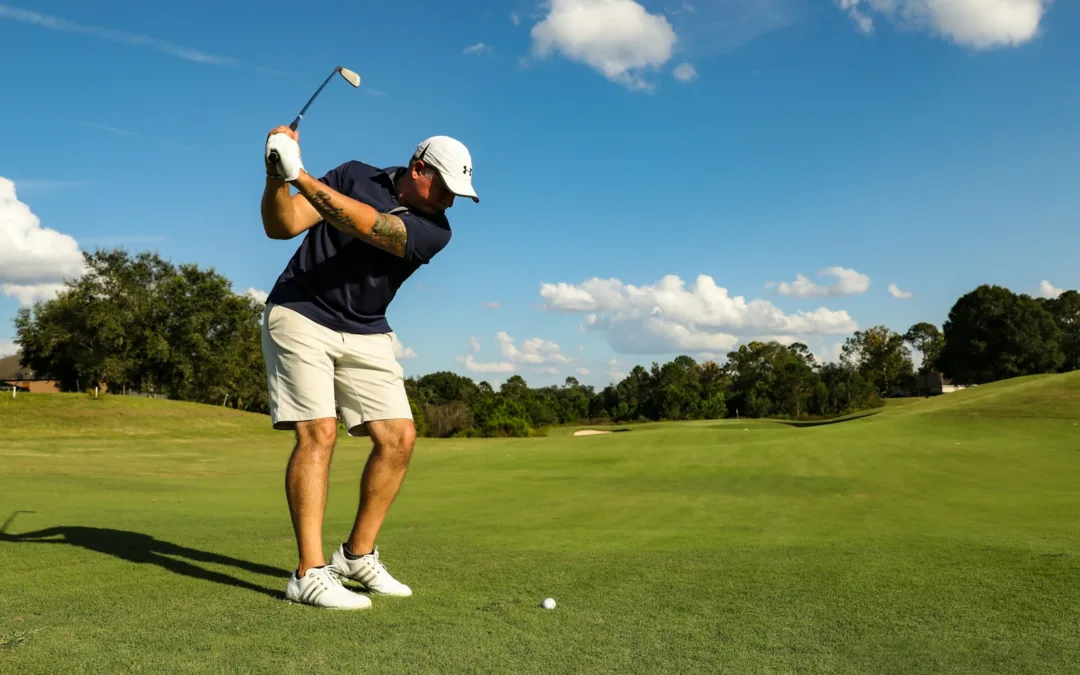
If you’ve had golfer’s elbow (also called medial epicondylalgia), you’ll know it’s not just a “sore elbow.” It’s pain gripping the steering wheel. Pain shaking hands. Pain turning a door handle. Pain gripping a golf club, a cricket bat, or the gym bar. Pain picking up your kids, or even just carrying the shopping in from the car.
And frustratingly, it can hang around for months, sometimes over a year. So why does golfer’s elbow take so long to improve? And are injections like cortisone really the quick fix people hope they are?
Let’s unpack it during this installment of Praxis What You Preach.
Golfer’s elbow is often thought of as tennis elbow’s quieter medial-side cousin. And in a lot of ways, that’s exactly right. If you haven’t already, it’s worth reading our companion piece, Why Tennis Elbow Takes So Long to Get Better. The underlying story of both conditions is remarkably similar. The difference is which side of the elbow, and which tendon, bears the load.
FIRST: IT’S NOT REALLY “INFLAMMATION”
For years golfer’s elbow was called “medial epicondylitis.” The “-itis” was meant to imply inflammation. But when researchers actually biopsied the affected tendon tissue, they didn’t find classic inflammatory cells. What they found was disorganised collagen, immature scar-like tissue, and small blood vessel changes: a picture of degeneration and failed healing, not inflammation (Konarski et al., 2023). That’s why clinicians increasingly prefer the term medial epicondylalgia, or simply call it what it is: a tendinopathy.
The tendon involved is the common flexor-pronator tendon, which attaches to the medial epicondyle (the bony bump on the inside of your elbow). The main offenders are pronator teres and flexor carpi radialis, the muscles that pronate your forearm and flex your wrist. Those are exactly the actions used in a golf swing, a bowling or throwing action, hammering, or repetitive gripping and lifting at work (Konarski et al., 2023). Occupational studies confirm this: forceful gripping and forceful hand-arm exertion are consistently linked with medial epicondylitis, more so than simple repetition alone (Descatha et al., 2003).
This distinction matters clinically. If it were true inflammation, anti-inflammatories and rest would fix it. But because it’s a tendon struggling to remodel and rebuild under load, the fix looks very different, and slower.
WHY IT TAKES SO LONG TO HEAL
Tendon is a tough, relatively low-blood-supply tissue, and it doesn’t rebuild itself quickly. Degenerative tendon changes take time to reverse because the collagen matrix needs to be gradually remodelled through the right amount and type of loading. Too little load and the tendon never adapts; too much, too soon, and you re-irritate it.
This is reflected in how long people tend to have symptoms before they get proper treatment. In one of the key clinical studies on eccentric exercise for golfer’s elbow, patients presenting for treatment had a mean symptom duration of 19 months before starting a structured loading program (Svernlov et al., 2012). Golfer’s elbow is also less common and less studied than tennis elbow, making up roughly 10-20% of all epicondylitis presentations (Wiggins et al., 2018). That partly explains why it’s under-recognised and often mismanaged early, allowed to become chronic before it’s treated properly.
The encouraging part: even patients with long-standing, previously unsuccessfully treated golfer’s elbow can still improve substantially with the right rehabilitation approach. It’s about matching the treatment to what’s actually going on in the tissue (Svernlov et al., 2012).
CORTISONE, PRP, OR LOADING: WHAT DOES THE EVIDENCE ACTUALLY SHOW?
Cortisone injections are still commonly offered for golfer’s elbow, and they do work, in the short term. A direct trial comparing corticosteroid injection with platelet-rich plasma (PRP) in golfer’s elbow patients found the steroid group improved faster in the first month (mean VAS pain score dropping from 5.8 to 3.2). By six months, though, the PRP group had pulled clearly ahead on both pain and function (DASH) scores, with the steroid group’s improvement plateauing at a comparatively higher pain and disability level (Chandrasekaran et al., 2022). In other words: cortisone can quiet things down quickly, but it doesn’t fix the underlying tendon problem, and outcomes can stall or regress.
PRP injections have shown promise for longer-term outcomes in epicondylitis generally, but they’re an adjunct, not a substitute for loading the tendon appropriately. Access, cost, and evidence quality still vary (Konarski et al., 2023).
Meanwhile, structured eccentric loading, the kind a physiotherapist can prescribe and progress, has produced meaningful, durable reductions in pain and improvements in grip strength in dedicated golfer’s elbow studies. Those benefits are maintained at long-term follow-up (Svernlov et al., 2012). It doesn’t work as fast as a needle. But it addresses the actual problem: a tendon that hasn’t had the chance to rebuild its capacity.
WHAT ACTUALLY WORKS
The most consistent, evidence-backed approach is physiotherapy-directed progressive loading of the flexor-pronator group:
Starting with isometric holds to settle pain and maintain strength without aggravating the tendon. Progressing to slow, controlled eccentric and concentric loading of wrist flexion and forearm pronation. Rebuilding grip strength specifically, since grip deficits are common and closely tied to function. Addressing the whole kinetic chain, shoulder, scapular control, and even trunk rotation for golfers and throwers, rather than treating the elbow in isolation. Gradually reintroducing the golf swing, throw, or gym lift once the tendon can tolerate real load.
We don’t currently have a golfer’s-elbow-specific wrist-flexor loading video on our YouTube channel yet. That’s something we should film, so patients have a clear visual guide to follow at home alongside their program.
The Takeaway
Golfer’s elbow isn’t inflammation. It’s a tendon that has lost capacity and needs to rebuild it. That rebuilding takes months, not days, and there’s no shortcut that bypasses the loading process. Cortisone can help short-term flare-ups, but it isn’t a fix. PRP may help longer-term outcomes as an adjunct. The most reliable path back to pain-free gripping, swinging, and lifting is a physiotherapy-guided progressive loading program tailored to your tendon, your sport, and your goals.
Book an appointment at one of our Brisbane clinics today and start moving forward with a clear plan.
Until next time, Praxis What You Preach…
📍 Clinics in Teneriffe, Woolloongabba, and Carseldine
💪 Trusted by athletes. Backed by evidence. Here for everyone.
Related Articles

Why Tennis Elbow Takes So Long to Get Better (And What Actually Works)
Rotator Cuff Repair: A Physiotherapy Guide on Recovery and Rehabilitation
Shoulder Stabilisation and Bankart Repair: Your Path Back to Sport
Chandrasekaran N, Manokaran SV, Jayakaran HB, Ganesh GS. Comparison Between Steroid and PRP Injections in Medial Epicondylitis (Golfer’s Elbow) Patients. International Journal of Pharmaceutical Sciences and Research. 2022;13(12):5139-5144.
Descatha A, Leclerc A, Chastang JF, Roquelaure Y. Medial epicondylitis in occupational settings: prevalence, incidence and associated risk factors. Journal of Occupational and Environmental Medicine. 2003;45(9):993-1001.
Konarski W, Pobozy T, Pobozy K, Domanska J, Konarska K. Current concepts of natural course and in management of medial epicondylitis: a clinical overview. Orthopedic Reviews. 2023;15:84275.
Svernlov B, Hultgren E, Adolfsson L. Medial epicondylalgia (golfer’s elbow) treated by eccentric exercise. Shoulder & Elbow. 2012;4(1):50-55.
Wiggins AJ, Cancienne JM, Camp CL, Degen RM, Altchek DW, Dines JS, Werner BC. Disease Burden of Medial Epicondylitis in the USA Is Increasing: An Analysis of 19,856 Patients From 2007 to 2014. HSS Journal. 2018;14(3):233-237.