


Hamstring strains have a reputation, and it’s not a good one. They are one of the most common injuries in running and field sports, and they are notorious for coming back. Depending on the sport, somewhere between one in five and one in three athletes who return after a hamstring strain re-injure the same muscle within the following year. That reinjury often happens within the first few weeks of full training. The usual culprit isn’t bad luck. It’s returning to sport on a calendar instead of on evidence that the muscle is actually ready to take the load again.
The Nordic hamstring curl test is one of the most useful tools physiotherapists have for closing that gap. It doesn’t just tell you whether a hamstring feels okay. It tells you how much eccentric strength the muscle can produce under load, which is the exact quality that gets punished in the final stride of a sprint.
WHAT THE TEST ACTUALLY MEASURES
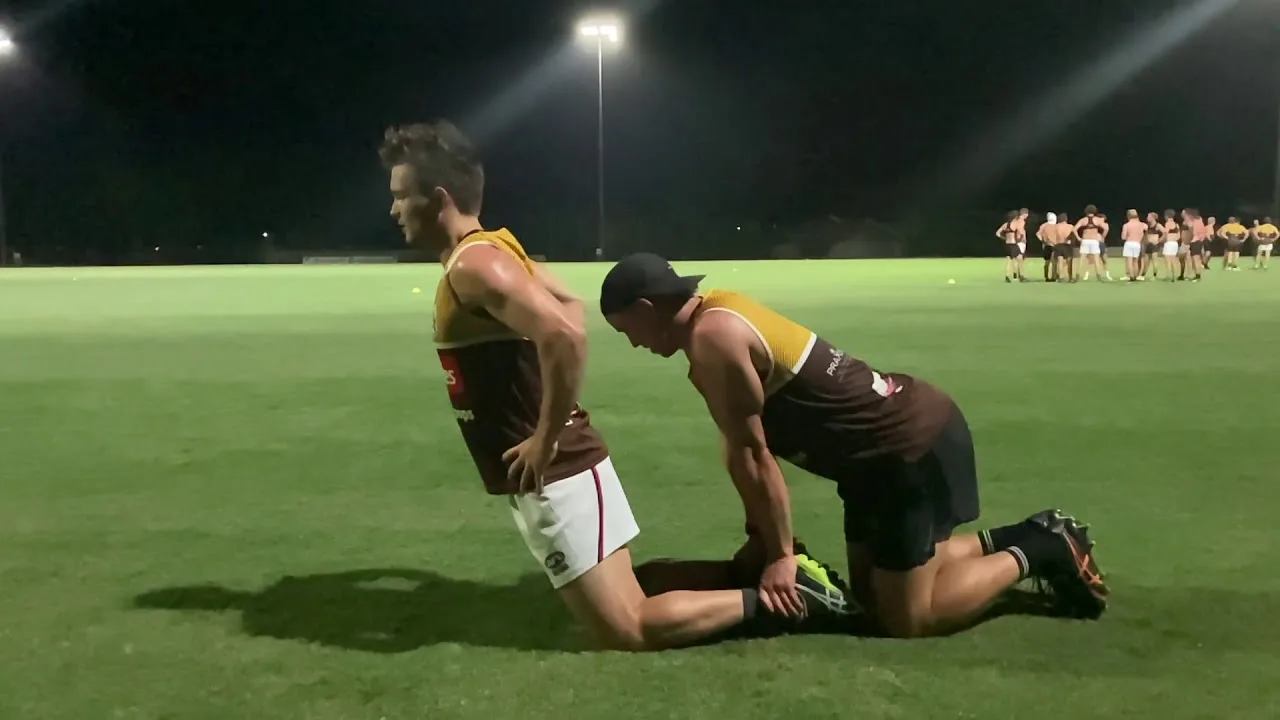
The test is performed kneeling, with the ankles fixed by a partner, a strap, or a purpose-built device such as a NordBord. From an upright kneeling position, you lower your body toward the floor as slowly as possible under control, using the hamstrings to resist gravity. Then you catch yourself with your hands at the point you can no longer control the descent. What’s being tested is eccentric hamstring strength: the muscle’s ability to produce force while lengthening. That’s precisely what happens in the split second before a hamstring tears during the late swing phase of sprinting.
A 2016 prospective cohort study of elite footballers by Timmins and colleagues was published in the British Journal of Sports Medicine. It found that players with weaker eccentric hamstring strength and shorter biceps femoris fascicles were significantly more likely to sustain a hamstring strain over the following season. Both qualities can be measured directly with Nordic curl testing, and both respond well to targeted training.
WHY TESTING BEATS GUESSING
Comparing left leg to right leg is only part of the picture with hamstrings. Both legs can be underprepared after a period of reduced training. What matters more is whether force output has been restored to pre-injury levels and whether it holds up across multiple repetitions, not just a single good attempt.
This objective approach is backed by a growing body of return-to-sport literature. A 2016 Delaware-Oslo cohort study by Grindem and colleagues followed athletes recovering from ACL reconstruction. Those who passed a battery of objective discharge criteria, rather than being cleared on time alone, had an 84% lower rate of reinjury. A related study by Kyritsis and colleagues found that athletes who returned to sport without meeting all discharge criteria were four times more likely to re-rupture their graft. Hamstring rehabilitation follows the same principle: numbers, not calendars, should decide when someone returns.
In practice, we retest through the later stages of hamstring rehab, tracking both absolute force and side-to-side symmetry. That way, return-to-running and return-to-sprint decisions are based on a trend, not a single good day.
THE KINETIC CHAIN COST OF CUTTING CORNERS
An under-recovered hamstring rarely fails in isolation. When the primary decelerator of the leg is weak, the body finds load somewhere else. That’s often the adjacent hip and groin muscles, or the same hamstring on the opposite leg as it compensates for altered running mechanics. The clearest evidence for this adjacent-site effect comes from ACL research. A 2016 systematic review by Wiggins and colleagues found a 15% overall rate of a second ACL injury in athletes returning to sport, split almost evenly between the same knee and the opposite knee. Hamstring-specific data is less complete, but the underlying principle holds across the kinetic chain. A muscle that returns to sport underprepared changes how load is shared through the rest of the leg, and that redistribution is often where the next injury shows up.
Repeated hamstring strains also compound over time. Each re-tear tends to leave more scar tissue and more fascicle shortening behind. That produces a muscle that is mechanically less able to absorb high-speed loading, which is exactly the pattern that predicts the next strain. Testing before return isn’t just about avoiding a setback this season. It’s about protecting the tissue quality that determines how the hamstring performs for years afterward.
WHAT WE DO AT PRAXIS
Our sports physiotherapists use Nordic curl testing alongside sprint mechanics assessment and graded loading progressions to build an objective picture of readiness, rather than relying on pain or time since injury alone. If you’re recovering from a hamstring strain, or you simply want to know where your numbers sit before pre-season, book a return-to-sport assessment with our team.
Until next time, Praxis What You Preach…
📍 Clinics in Teneriffe, Woolloongabba, and Carseldine
💪 Trusted by athletes. Backed by evidence. Here for everyone.
Related Articles
Nordic Curls and the Copenhagen Plank: Two Exercises That Could Save Your Season
Hamstring Strain Injuries: Lessons from Personal Experience and the Latest Research
Return to Sport Testing: The Complete Guide
References
Timmins RG, Bourne MN, Shield AJ, Williams MD, Opar DA. Short biceps femoris fascicles and eccentric knee flexor weakness increase the risk of hamstring injury in elite football (soccer): a prospective cohort study. British Journal of Sports Medicine. 2016;50(24):1524-1535.
Grindem H, Snyder-Mackler L, Moksnes H, Engebretsen L, Risberg MA. Simple decision rules can reduce reinjury risk by 84% after anterior cruciate ligament reconstruction: the Delaware-Oslo ACL cohort study. British Journal of Sports Medicine. 2016;50(13):804-808.
Kyritsis P, Bahr R, Landreau P, Miladi R, Witvrouw E. Likelihood of ACL graft rupture: not meeting six clinical discharge criteria before return to sport is associated with a four times greater risk of rupture. British Journal of Sports Medicine. 2016;50(15):946-951.
Wiggins AJ, Grandhi RK, Schneider DK, Stanfield D, Webster KE, Myer GD. Risk of secondary injury in younger athletes after anterior cruciate ligament reconstruction: a systematic review and meta-analysis. American Journal of Sports Medicine. 2016;44(7):1861-1876.