Sciatica: Why That Shooting Leg Pain Isn’t the Life Sentence It Feels Like

Sciatica: Why That Shooting Leg Pain Isn’t the Life Sentence It Feels Like

You bend down to pick up a bag of groceries and suddenly there’s a hot, electric line running from your lower back, through your buttock and down the back of your leg. Sometimes it stops at the knee. Sometimes it doesn’t stop until it reaches your foot. Sitting at your desk makes it worse. Getting out of the car has become a slow, careful production. You might have pins and needles down your calf, or a strange numb patch on the sole of your foot that just won’t settle. Sleep is a nightmare!

This is sciatica. If you’re reading this because you’re living through it right now, we want to tell you two things straight away: it is genuinely as unpleasant as it feels, and the overwhelming majority of people recover well without ever needing surgery.
At Praxis, we see sciatica walk through our Teneriffe, Woolloongabba and Carseldine clinics every single week. It rarely looks the same twice. Some people are gritting their teeth through a full workday, others can barely get out of bed, but the questions are almost always identical. What’s actually causing this? Do I need a scan? Am I going to end up on an operating table? Let’s work through it properly.

WHAT’S ACTUALLY GOING ON?
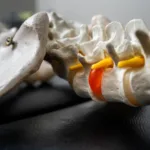
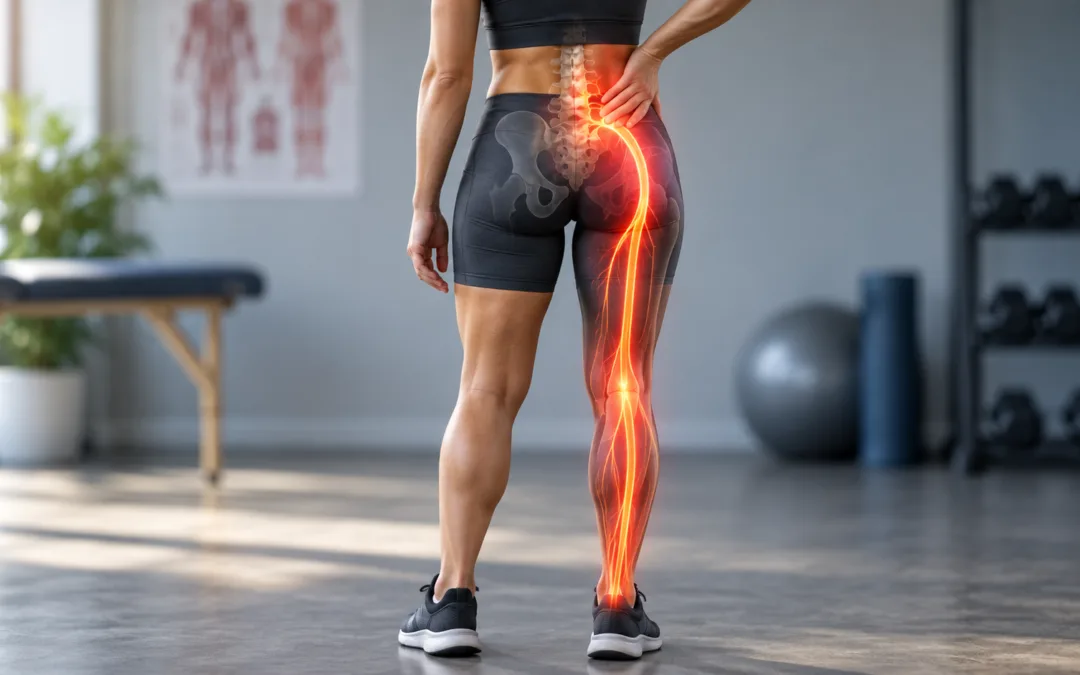
Close-up of a human spine model with red disc“Sciatica” isn’t really a diagnosis. It’s a description of a symptom pattern: pain that travels down the leg, usually below the knee. That pain is caused by irritation or compression of one of the nerve roots that form the sciatic nerve as it exits the spine. The most common culprit is a disc herniation pressing on or chemically irritating a nearby nerve root. Spinal stenosis (narrowing around the nerve) can also produce a similar picture (Peul et al., 2007). The nerve itself doesn’t like being squashed or inflamed, and it lets you know about it. That shows up as the burning, the pins and needles, sometimes the numbness or weakness.

Here’s the genuinely reassuring part: disc herniations are not permanent structural damage that you’re stuck with forever. A 2023 systematic review and meta-analysis found that a large proportion of herniated discs shrink on their own over time, with sequestered and extruded fragments regressing most reliably (Rashed et al., 2023). Your body is, quite literally, built to clean this mess up.

IS BED REST THE ANSWER?

This is probably the single biggest myth we bust in clinic. It feels logical: it hurts, so surely you should stop moving? The evidence says otherwise. A Cochrane systematic review comparing bed rest against staying active for acute low back pain and sciatica found no meaningful difference in pain or function between the two approaches. Prolonged bed rest also carries its own risks, deconditioning, stiffness, low mood, so the sensible advice is to stay as active as your symptoms allow (Dahm et al., 2010). We’ve written more on why waiting it out, or over-resting, can actually leave you worse off in our post on why the wait and see approach may leave you with a poorer outcome.

WHAT ABOUT SCANS AND IMAGING?

“I just need an MRI so we know exactly what’s wrong” is one of the most common requests we hear, and it’s completely understandable. But for most people with sciatica, in the absence of red flags like progressive weakness, loss of bladder or bowel control, or unexplained weight loss, early imaging doesn’t change the treatment plan or improve outcomes. A landmark systematic review and meta-analysis in The Lancet found that routine, immediate lumbar imaging does not improve pain, function, or quality of life compared with usual clinical care guided by a thorough physical assessment (Chou et al., 2009). Scans also frequently pick up disc bulges and degenerative changes in people with zero symptoms, which can create unnecessary alarm rather than clarity. We’ve unpacked this in detail in Fact or Fiction Friday: Lower Back Pain and MRI’s, well worth a read if a scan is on your mind.

WHAT ABOUT MEDICATION?

Physiotherapy addresses the mechanical and neural side of sciatica: movement, strength, and nerve mobility. It doesn’t extend to prescribing. When pain is severe enough to disrupt sleep or stop you engaging with early rehab, a good working relationship with your GP becomes genuinely important, and it’s a part of care that sits outside our scope as physios. According to PubMed, a systematic review of drug trials for sciatica found short courses of corticosteroids produced a modest short-term reduction in leg pain compared with placebo (Pinto et al., 2012). The picture is less encouraging for gabapentin and pregabalin. Despite being commonly prescribed for nerve-related pain, more recent systematic reviews have found little to no meaningful benefit over placebo for pain or disability, alongside a higher rate of side effects (Enke et al., 2018). This is exactly why the GP relationship matters here. Judicious, time-limited medication, guided by someone who’s across the current evidence, can take the edge off pain while your physiotherapy program does the actual rehabilitative work. It isn’t a substitute for that work. We’re always happy to liaise directly with your GP to keep both sides of your care working toward the same plan.

WILL I NEED SURGERY?

Sometimes, but far less often than people assume. A landmark Dutch trial found that early surgery relieved sciatica symptoms roughly twice as fast as prolonged conservative care. Even so, one-year functional outcomes between the two groups ended up much the same (Peul et al., 2007). More recently, a 2020 randomised trial looked at people with sciatica lasting four to twelve months. Surgery did offer faster and somewhat greater pain relief for that specific, more stubborn subgroup, but conservative management still delivered meaningful improvement for many (Bailey et al., 2020). In short: surgery is a legitimate option for a minority of people with severe, persistent, or worsening symptoms. It is not the default pathway for most people with sciatica.

WHAT ACTUALLY WORKS

This is where good physiotherapy earns its keep. A 2023 systematic review and meta-analysis noted the evidence base for specific physiotherapy interventions is still maturing and heterogeneous. Even so, physiotherapy, including graded exercise, education, and a program tailored to your specific presentation, remains recommended as a sensible first-line approach for most people with sciatica (Dove et al., 2023). One technique with growing support is neural mobilisation, sometimes called “nerve gliding” or “nerve flossing”: gentle movements designed to help the irritated nerve move more freely through the surrounding tissue. A 2023 meta-analysis of 20 randomised trials found neural mobilisation meaningfully reduced pain and disability in people with lumbar radiculopathy (Lin et al., 2023). It’s a technique we use regularly in clinic, and it’s about time we filmed a short nerve-glide demonstration video for our YouTube channel so you can see exactly what it looks like.

For a broader look at how we approach the low back more generally, our Lower Back Pain page is a good next stop.

THE TAKEAWAY

Sciatica is miserable to live with, but it is rarely dangerous, rarely permanent, and rarely a surgical emergency. Most people improve with time, staying reasonably active, and a physiotherapy program that addresses your specific movement pattern, strength, and nerve mobility, not with bed rest, and usually not with an early scan either. The goal isn’t just to wait it out and hope; it’s to actively guide your recovery so you get back to your normal life faster and with less risk of it flaring up again. If that shooting leg pain has been part of your daily routine for more than a week or two, come and see us at Praxis in Teneriffe, Woolloongabba, or Carseldine. We’ll assess you properly, rule out anything that needs urgent attention, and build you a plan that gets you moving again.

Until next time, Praxis What You Preach…

📍 Clinics in Teneriffe, Woolloongabba, and Carseldine

💪 Trusted by athletes. Backed by evidence. Here for everyone.

Related Articles
Deep Gluteal Syndrome: The Buttock Pain That Mimics Sciatica

That deep, nagging ache in your buttock might not be sciatica at all. Here’s how deep gluteal syndrome differs, and what helps.

Femoroacetabular Impingement (FAI): The Groin Pain Behind Your Squat and Sitting Trouble
If you’re young, active, and you’ve developed a nagging pinch of groin pain, femoroacetabular impingement could be behind it.

Why Your Glutes Aren't Lazy, They're Underdeveloped

Clamshells before squats, banded lateral walks before a run. Here’s why your glute activation routine might be missing the point.
References

Bailey, C.S., Rasoulinejad, P., Taylor, D., Sequeira, K., Miller, T., Watson, J., Rosedale, R., Bailey, S.I., Gurr, K.R., Siddiqi, F., Glennie, A., & Urquhart, J.C. (2020). Surgery versus conservative care for persistent sciatica lasting 4 to 12 months. New England Journal of Medicine, 382(12), 1093-1102.

Chou, R., Fu, R., Carrino, J.A., & Deyo, R.A. (2009). Imaging strategies for low-back pain: Systematic review and meta-analysis. The Lancet, 373(9662), 463-472.

Dahm, K.T., Brurberg, K.G., Jamtvedt, G., & Hagen, K.B. (2010). Advice to rest in bed versus advice to stay active for acute low-back pain and sciatica. Cochrane Database of Systematic Reviews, Issue 6.

Dove, L., Jordan, J., Chen, Y-F., Foster, N.E., & Konstantinou, K. (2023). How effective are physiotherapy interventions in treating people with sciatica? A systematic review and meta-analysis. European Spine Journal, 32(2), 517-533.

Enke, O., New, H.A., New, C.H., Mathieson, S., McLachlan, A.J., Latimer, J., Maher, C.G., & Lin, C.W. (2018). Anticonvulsants in the treatment of low back pain and lumbar radicular pain: A systematic review and meta-analysis. CMAJ, 190(26), E786-E793.

Lin, L-H., Lin, T-Y., Chang, K-V., Wu, W-T., & Ozcakar, L. (2023). Neural mobilization for reducing pain and disability in patients with lumbar radiculopathy: A systematic review and meta-analysis. Life, 13(12), 2255.

Peul, W.C., van Houwelingen, H.C., van den Hout, W.B., Brand, R., Eekhof, J.A.H., Tans, J.T.J., Thomeer, R.T.W.M., & Koes, B.W. (2007). Surgery versus prolonged conservative treatment for sciatica. New England Journal of Medicine, 356(22), 2245-2256.

Pinto, R.Z., Maher, C.G., Ferreira, M.L., Ferreira, P.H., Hancock, M., Oliveira, V.C., McLachlan, A.J., & Koes, B. (2012). Drugs for relief of pain in patients with sciatica: Systematic review and meta-analysis. BMJ, 344, e497.

Rashed, S.S., Vassiliou, A., Starup-Hansen, J., & Tsang, K. (2023). Systematic review and meta-analysis of predictive factors for spontaneous regression in lumbar disc herniation. Journal of Neurosurgery: Spine, 39(4), 471-483.
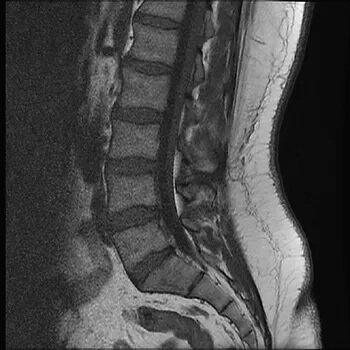
Fact or Fiction Friday – Lower back Pain and MRI’s

Fact or Fiction Friday – Lower back Pain and MRI’s

I need to get an MRI to help with the management of my lower back pain

Answer – FICTION

The Evidence

In a recent narrative review, Wang and colleagues (2018) concluded that MRI imaging in the early stages of lower back pain can have detrimental effects including more pain, less improvement, higher risk of surgery and worse overall health status. In fact, one study reported that patients that received an MRI within the first month had an 8x greater risk for surgery and 5x more medical costs!

If you do NOT present with severe neurological deficits, signs of a serious or specific underlying condition or have persistent pain >6 weeks which is unresponsive to conservative treatment then there likely isn’t a need for further investigation!

To get help with your long standing back pain or even that acute flare up, give us a call on (07) 3102 3337 or book online  so we can sort you out.

#praxiswhatyoupreach #praxisphysio #factorfictionfriday #physioeducation #preventprepareperform #pain #backpain #lowerbackpain #MRI #patienteducation

Wang Y, et al. Informed appropriate imaging for low back pain management: A narrative review. Journal of Orthopaedic Translation. 2018.

Until next time, Praxis What You Preach

📍 Clinics in Teneriffe, Buranda, and Carseldine

💪 Trusted by athletes. Backed by evidence. Here for everyone.

Related Articles

Pilates & Back Pain Rehab (Part 3 of 3): How Much Is Enough?

In Part 3 of our Pilates series, we explore how reformer-based Pilates can transition from…

Pilates: Reforming our back pain rehabilitation (Part 1 of 3)

With our 30 day pilates challenge starting today, we thought we would take a look at why w…

Lower Back Pain

Sharp catch of pain? Ongoing aches? Trouble getting out of bed or with long car rides? Sti…
Lower Back Pain

Lower Back Pain

Sharp catch of pain? Ongoing aches? Trouble getting out of bed or with long car rides? Stiff and sore when you are bending over to pick things up? Referred pain into you legs?

If you’ve experienced any of these symptoms recently you are not alone. Lower back pain is a common ailment affecting people of all ages and lifestyles with up to 80% of us experiencing various symptoms in our lifetime. Lower back pain can be caused by various factors such as poor posture, muscle strain, joint pain or underlying medical conditions.

Back pain is complex. These aches and pains are usually a sign that your spine are not tolerating loads well and are more sensitive than usual. Symptoms could arise from a subtle change in muscle balance and biomechanics, altered postures, novel or increases in training intensity or even your thoughts arounds the fragility of your spine. Physiotherapy offers effective solutions for managing and alleviating lower back pain by assessing the root cause of the pain, educating you on what is happening and develop personalised treatment plans. We also employ techniques like manual therapy, exercises, and stretches to strengthen you, improve flexibility, return you to activity and desensitise the painful area. Physiotherapy also includes education on proper body mechanics and ergonomics to prevent future episodes in activities such as lifting, sports or activitities of daily living.

Mid Potion Achilles Tendinopathy Location

Whatever the cause, our highly trained Praxis physiotherapists have expertise in this area and will help identify the problem and work with you so that you will feel empowered to fix the problem. At Praxis Physio, this is our point of difference. We promise to take the time to fix you using a range of modalities including advice, hands on manual therapies, reformer pilates and of course strength and conditioning programming.

No need to accept back pain as ‘normal’ call us now on (07) 3102 3337 or book online to have one of our physios get you back on track before your pain becomes any worse.

Team Praxis,

PREVENT | PREPARE | PERFORM

Until next time, Praxis What You Preach

📍 Clinics in Teneriffe, Buranda, and Carseldine

💪 Trusted by athletes. Backed by evidence. Here for everyone.

Photo from the Praxis Physiotherapy article: Lower Back Pain

Related Articles

Pilates & Back Pain Rehab (Part 3 of 3): How Much Is Enough?

In Part 3 of our Pilates series, we explore how reformer-based Pilates can transition from…

Pilates: Reforming our back pain rehabilitation (Part 1 of 3)

With our 30 day pilates challenge starting today, we thought we would take a look at why w…

Fact or Fiction Friday – Lower back Pain and MRI’s

I need to get an MRI to help with the management of my lower back pain Answer – FICT…
Pilates: Reforming our back pain rehabilitation (Part 1 of 3)

Pilates: Reforming our back pain rehabilitation (Part 1 of 3)

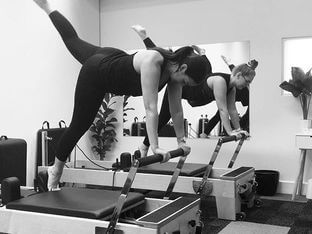
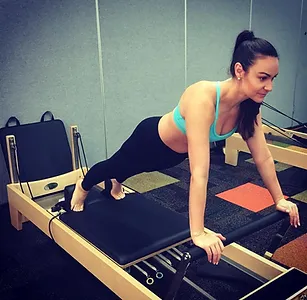
With our 30 day pilates challenge starting today, we thought we would take a look at why we love pilates so much for our patients, and what some of the benefits are. Part 1 looks at how pilates affect those with chronic lower back pain. Part 2 looks at the difference between mat and reformer pilates and part 3 looks at how often is required to see the benefit of pilates.

SUMMARY:

  • Back pain is extremely common, multifactorial, and often reoccurs
  • Strengthening interventions appear better for long term suffers of lower back pain
  • Pilates has been shown to improve muscular strength and endurance of key pelvic and postural musculature associated with lower back pain
  • Specifically, pilates promotes the restoration of the function of muscles involved in lumbopelvic stabilisation, that is, transversus abdominis, multifidus, diaphragm and pelvic floor muscles
  • As little as 2 sessions per week for 6 weeks has been shown to see improvements in pain and function for those with longstanding lower back pain, even after stopping pilates

Chronic low back pain (CLBP) is one of the commonest musculoskeletal problems in modern society (Anderson 1999) and is a highly prevalent in both the sporting and general public. CLBP is experienced by 70%–80% of adults at some time in their lives (Crombez et al 1999) and as such, the costs associated with LBP and related disability are enormous, causing a major economic burden for patients, governments and health insurance companies (Dagenais 2008).

Lower back pain has been one of the most extensively studied musculoskeletal conditions as a result of the prevalence and debilitation nature. Its management comprises a range of different intervention strategies including surgery, drug therapy and non-medical intervention like rehabilitation (Paolucci et al 2018). Within Physiotherapy, exercise therapy is probably the most commonly used intervention for the treatment of patients with chronic non-specific LBP due to its plausible biological rationale and low cost.

Whilst general conditioning programs to train strength and endurance of the spine musculature have been shown to reduce pain intensity and disability (Rainville et al 2004), the popularity of pilates (both mat and reformer) has helped provide an accessible and supervised form of therapeutic exercise.

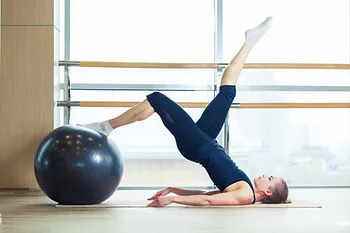
Photo from the Praxis Physiotherapy article: Pilates: Reforming our back pain rehabilitation (Part 1 of 3)

EVIDENCE FOR PILATES

The Pilates method, using functional exercises aims to improve muscular strength and endurance. Specifically, the pilates method have promotes the restoration of the function of muscles involved in lumbopelvic stabilisation, that is, transversus abdominis, multifidus, diaphragm and pelvic floor muscles. Using the principles of progressive overload, your body adapts to the incremental loading week after week and consequently results important postural control improvement. In 2009, Curnow and colleagues showed that the Pilates method improves load transfer through the pelvis, something that intuitively helps those with CLBP.

However, a systematic review (Patti et al 2015) reported evidence that Pilates method-based exercises are more effective than no treatment or minimal physical exercise interventions in the management of chronic nonspecific LBP. Further, they pointed out that the effects of the Pilates method are only proven for patients with chronic nonspecific LBP in the short term.

A recent study by Natour and colleagues (2015) showed that the group of participants that were practicing Pilates method resulted statistically better compared with the a non exercising group who only used inflammatory medication. Those who were in the pilates group used less pain medication at 45, 90 (conclusion of the Pilates method), and 180 days, 90 days after the conclusion of the exercise program.

In conclusion, Pilates as an exercise choice is more effective than minimal physical exercise or drug based interventions in reducing pain and disability in the short-term period. There is agreement that exercise “helps” in the treatment of chronic pain, but it is still not clear exactly which factors or particular kind of exercises may be responsible of such improvements (Natour et al 2015; Patti et al 2015). Praxis Physiotherapy has always been a strong proponent of movement and loading early in rehabilitation (more on this in later blogs!).

In the next instalment, we discuss the difference between mat and reformer pilates and perhaps find some more answers regarding which exercise regime reigns supreme!

Check out all our other reformer pilates services on our website

Until next time,

Until next time, Praxis What You Preach

📍 Clinics in Teneriffe, Buranda, and Carseldine

💪 Trusted by athletes. Backed by evidence. Here for everyone.

References:

  1. Andersson GB. Epidemiological features of chronic low-back pain. Lancet. 1999;354(91789178):581–585.
  2. Crombez G, Vlaeyen JW, Heuts PH, Lysens R, Crombez G. Pain-related fear is more disabling than pain itself: evidence on the role of pain-related fear in chronic back pain disability. Pain. 1999;80(1-2):329–339.
  3. Dagenais DC, Caro J, Haldeman S. A systematic review of low back pain cost of illness studies in the United States and internationally. The Spine Journal 2008;8(1):8‐20.
  4. Paolucci, T., Attanasi, C., Cecchini, W., Marazzi, A., Capobianco, S. V., & Santilli, V. (2019). Chronic low back pain and postural rehabilitation exercise: a literature review. Journal of pain research, 12, 95.
  5. Rainville J, Hartigan C, Martinez E, Limke J, Jouve C, Finno M. Exercise as a treatment for chronic low back pain. Spine J. 2004;4:106-115
  6. Patti, A., Bianco, A., Paoli, A., Messina, G., Montalto, M. A., Bellafiore, M., … & Palma, A. (2015). Effects of Pilates exercise programs in people with chronic low back pain: a systematic review. Medicine, 94(4).
  7. Curnow, D., Cobbin, D., Wyndham, J., & Choy, S. B. (2009). Altered motor control, posture and the Pilates method of exercise prescription. Journal of bodywork and movement therapies, 13(1), 104-111.
  8. Natour, J., Cazotti, L. D. A., Ribeiro, L. H., Baptista, A. S., & Jones, A. (2015). Pilates improves pain, function and quality of life in patients with chronic low back pain: a randomized controlled trial. Clinical rehabilitation, 29(1), 59-68.

Related Articles

Pilates: Mat vs Reformer Pilates (Part 2 of 3)

In part one, we unearthed that pilates has a role to play in reducing the severity of chro…

Pilates & Back Pain Rehab (Part 3 of 3): How Much Is Enough?

In Part 3 of our Pilates series, we explore how reformer-based Pilates can transition from…

Fact or Fiction Friday – Lower back Pain and MRI’s

I need to get an MRI to help with the management of my lower back pain Answer – FICT…
Pilates Launch Day! Northside Clinic

Pilates Launch Day! Northside Clinic

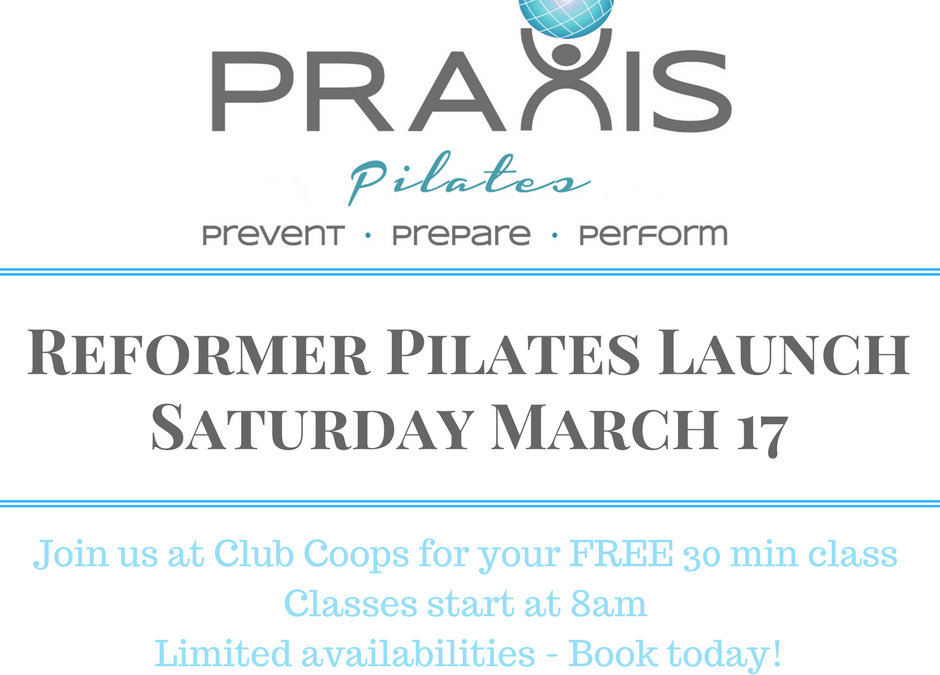
OPENING DAY || Exciting times at Praxis! We are stoked to be launching our reformer pilates classes @clubcoops on Saturday March 17. We have FREE 30min classes starting at 8am with Emma and Tara! Opening day specials available! Email or call (07) 3102 3337 or chat to the Club Coops front desk to secure your FREE class today! www.praxisphysio.com.au