Hamstring Strain Injuries: Lessons from Personal Experience and the Latest Research

Hamstring Strain Injuries: Lessons from Personal Experience and the Latest Research

Recently, in an effort to keep the ballooning effects of the all-you-can-eat buffet at bay during my Cricket Australia Indian tour, I ramped up my high-intensity running load. Things were going splendidly — four days of high-intensity running under my belt — until day five, when 90% of the way through a very intense interval session, I tore my hamstring.

I felt the tell-tale sensation so many of my patients describe: a sharp tearing and retraction sensation in my outer thigh while sprinting. I had to pull up immediately and iced the injury straight away. You’ll be happy to hear that I’ve since fully recovered. No longer ‘gun shy’ at my top speeds (which, admittedly, are not that fast!), my strength has vastly improved, and I’m back running at full capacity.

Having treated countless hamstring injuries through my long involvement in recreational, semi-elite, and elite sport — especially with Cricket Australia teams and the Aspley Hornets NEAFL squad — this experience gave me even deeper appreciation for how tricky these injuries can be. Hamstring strains are one of the most common injuries in running athletes, responsible for significant downtime and lost performance. Hamstring injuries have remained the most prevalent injury in professional AFL for the past 21 consecutive seasons (Orchard et al., 2013), with the average 2012 injury costing clubs over $40,000 per player!

Understanding Hamstring Injury Mechanisms

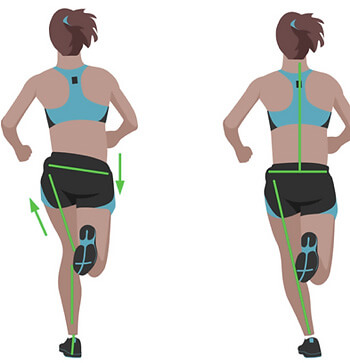
Most hamstring tears occur during the late-swing phase of running, where the hamstring undergoes rapid lengthening while producing high forces (Danielsson et al., 2020). Key risk factors include:

  • High eccentric loading demands.

  • Poor neuromuscular control.

  • Muscle imbalances (particularly hamstrings vs quadriceps).

  • Fatigue — as evidenced by my own injury, occurring late in a demanding session!

Importantly, the long head of biceps femoris is the most commonly injured muscle, partly due to its higher proportion of fast-twitch fibers and its anatomical position under stretch during running (Martin et al., 2022).

Fatigue, poor trunk/pelvic control, and sudden spikes in high-speed running are emerging as significant contributors to hamstring strain risk, particularly in field and court sports (Martin et al., 2022).

Preventing Hamstring Injuries

The good news is, hamstring injuries can often be prevented with smart training. Strengthening the hamstrings through eccentric exercises like Nordic hamstring curls and single-leg Romanian deadlifts has been shown to reduce injury rates significantly (Al Attar et al., 2017; Martin et al., 2022).

Effective prevention programs should also include:

  • Agility and trunk stabilization exercises — not just strength work (Martin et al., 2022).

  • Warm-up routines with dynamic stretching and sport-specific drills.

  • Monitoring high-speed running loads to avoid sudden spikes in intensity.

Addressing muscle imbalances is key too. Maintaining a healthy strength ratio between the quadriceps and hamstrings — and ensuring good trunk and gluteal control — promotes optimal biomechanics and reduces injury risk (Martin et al., 2022).

Recovering Well After a Hamstring Injury

A proper recovery should include:

  • Early management: Controlling swelling and pain with ice and appropriate activity modification.

  • Progressive eccentric strengthening: Integrated carefully to build resilience.

  • Functional rehabilitation: Sprinting drills, agility work, and sport-specific movements are crucial before returning to full play (Martin et al., 2022).

Interestingly, studies show athletes who follow programs that include eccentric training and trunk stability work have lower reinjury rates than those who just focus on basic strength and stretching (de Visser et al., 2012; Martin et al., 2022).

Return-to-play decisions should be made carefully. Factors like strength symmetry, absence of pain, and readiness for high-speed running should all be considered to reduce the risk of reinjury, which can be as high as 30% otherwise (Martin et al., 2022).

Final Thoughts

Even as a physio, my personal hamstring tear was a stark reminder that fatigue, progressive loading, and structured rehab are vital ingredients for both prevention and recovery. Whether you’re a weekend warrior, a professional cricketer, or just trying to beat the buffet, hamstring health is crucial.

If you’d like help strengthening your hamstrings, managing an existing injury, or optimising your running and performance, feel free to reach out. I (and my hamstrings) would be happy to help!

Till next time, Praxis what you Preach!

Backed by evidence. Trusted by athletes. Here for every body.

References

  • Al Attar, W.S.A., et al. (2017). The effectiveness of injury prevention programs in reducing the incidence of hamstring injuries in soccer players: a systematic review and meta-analysis. Journal of Physiotherapy, 63(1), 11–17.

  • Danielsson, B., et al. (2020). Mechanisms of hamstring strain injury: current concepts. Sports Medicine, 50(4), 669–682.

  • Martin, R.L., et al. (2022). Hamstring strain injury in athletes: Clinical Practice Guidelines. Journal of Orthopaedic & Sports Physical Therapy, 52(3), CPG1–CPG44.

  • Orchard, J.W., et al. (2013). AFL Injury Report 2012.
Stingers AKA Neural traction injuries

Stingers AKA Neural traction injuries

SUMMARY:

  • Stingers are essentially a tractioning of the neural system
  • This can cause pain, movement and sensation changes
  • Chronic traction to the nervous system can have a cumulative effect on nerve function
  • The more damage to the nerve, the more serious the outcome
  • We shouldn’t be as dismissive of “stingers”, particularly if they are recurrent
  • Physiotherapy has a role to play

STINGERS:

Stingers have been the catch cry of many contact sports over the years. Often dismissed as ‘just a stinger’, trauma to the nervous system should probably be taken a little more seriously, as we delve into detail today.

Stingers are most commonly experienced in contact sports whereby the shoulder of a players is forcefully depressed, as experienced with a tackle in NRL or union. A large range of motion over a short period of time can result in a ‘traction’ of the Brachial Plexus (a network of nerves formed from exiting branches of the spinal cord in the neck that transverse to the shoulder and arm). Thus network of nerves sends signals from your spinal cord to your shoulder, arm and hand and thereby providing feeling and movement to these regions.

BACKGROUND:

To understand a stinger injury, a clear understanding of nerves and nerve related injuries is required. A nerve is an enclosed, cable-like bundle of nerve fibres called axons, in the peripheral nervous system. A nerve provides a common pathway for the electrochemical nerve impulses that provide a number of functions, including getting our muscles to move!

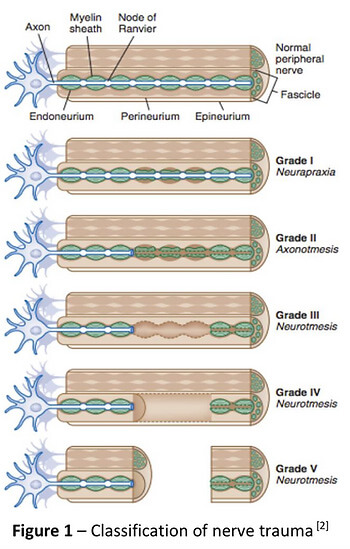
Seddon and Sunderland present a five-grade classification scale for nerve related injuries[1-4]. Figure 1 illustrates the physiological changes that occur through each grade of injury. Essentially it outlines the greater amount of disruption to the anatomy of the nerve.

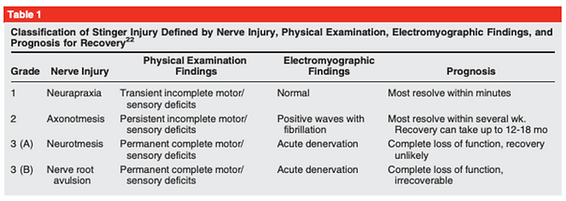
The more damage to the nerve, the more serious the outcome. Table 1 outlines the three different grades of stinger injuries.[4, 5] The most common stinger is a grade 1 injury, which represents a neurapraxia, or nerve stretch injury, without axonal disruption.[4] In an acute setting, this can result in motor and sensory loss/changes, which usually resolve within minutes.[1, 4] Grade 2 and 3 involve a higher degree of nerve injury, usually involving a crush, transection or compression mechanism.[1]

Chronic traction to the nervous system can have a cumulative effect on nerve function. This is termed “chronic stinger syndrome” and represents a distinct entity from acute stingers that may reflect long- standing structural changes of the subaxial spinal canal and chronic irritation/degeneration of the exiting nerve root complex.[4, 6]. This sounds complex but essentially means

Mid Potion Achilles Tendinopathy Location

A Clinical Example from Zac

“During a Gridiron match, a player was injured whilst making a tackle. I reviewed the player on field and he was unable to utilise his right upper limb (full paralysis) from shoulder down to his hand. The player was removed from the field immediately to be further assessed and monitored. A complete neurovascular assessment was performed, assessing motor function/strength, sensation, reflexes, and vascular status, as well was the cervical spine. Motor and sensation changes were the only deficits noted and were reviewed frequently. After roughly five minutes, the player demonstrated full upper limb motor strength and sensation, with nil lingering symptoms. In collaboration with the patient, it was decided he would return to match play immediately. The patient was monitored throughout the game and reported no further symptoms.”

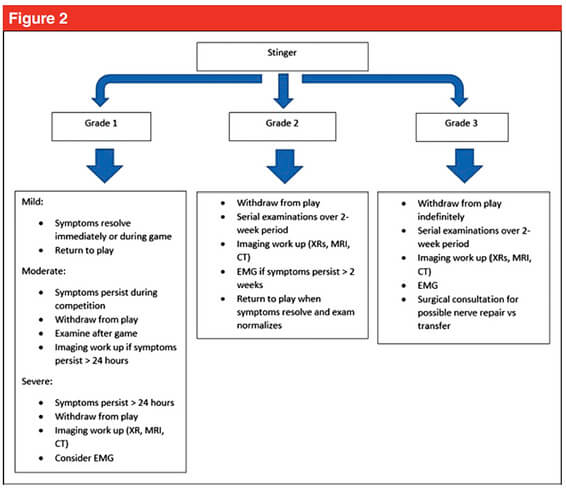
Figure 2 shows a proposed decision tree when managing stinger injuries.[4] This clinical example outline above fits the Grade 1 Mild category as he was able to return to competition with nil lingering symptoms. Despite the lack of symptoms during the game, it is recommended the patient be reviewed again both after the game and weekly for two weeks to ensure a full resolution of symptoms.[4, 7]

The role for neural mobilisation?

Current non-surgical management involves rest, pain control and resistance training[4]. Though not explored within the literature, neural mobilization may have an important role in patients with persistent symptoms, such as Grade 1 moderate to severe, and more recurrent neuropraxias. Though not assessed in this specific population, there is evidence for neural tissue management being superior to minimal intervention for pain relief and reduction of disability in nerve related chronic musculoskeletal pain.[8] It is biologically plausible that recurrent neuropraxias may respond in a similar way, utilising neural mobilisation (tensioning or sliding) and mobilisation of surrounding structures.

Management of persistent Grade 1 injuries may differ slightly, specifically if the suspected mechanism of injury was through traction rather than compression. The nerve structures may have a heightened sensitivity to tensioning based techniques due to the similar mechanism of injury and may respond better acutely to sliding techniques which limit the strain on the nerve and focus on excursion. Tensioning techniques may be important in the sub-acute phase by loading the patient’s nervous system (i.e. increased strain) in preparation for return to function (i.e. tackling with acute traction on the brachial plexus).

In summary, perhaps we shouldn’t be as dismissive of “stingers”, particularly if they are recurrent for you! If you have any questions or would like to see one of our physios regarding your injury, feel free to contact us on (07) 3102 3337 or book online on our website

Till next time, Praxis what you Preach

Team Praxis

Prevent | Prepare | Perform

REFERENCES:

Menorca, R.M.G., T.S. Fussell, and J.C. Elfar, Nerve physiology: mechanisms of injury and recovery. Hand clinics, 2013. 29(3): p. 317-330.

Tsao B, B.N., Bethoux F, Murray B, Trauma of the Nervous System, Peripheral Nerve Trauma. 6th ed. In: Daroff: Bradley’s Neurology in Clinical Practice. 2012.

Sunderland, S., A classification of peripheral nerve injuries producing loss of function. Brain, 1951. 74(4): p. 491-516.

Ahearn, B.M., H.M. Starr, and J.G. Seiler, Traumatic Brachial Plexopathy in Athletes: Current Concepts for Diagnosis and Management of Stingers. J Am Acad Orthop Surg, 2019.

Feinberg, J.H., Burners and stingers. Phys Med Rehabil Clin N Am, 2000. 11(4): p. 771-84.

Presciutti, S.M., et al., Mean subaxial space available for the cord index as a novel method of measuring cervical spine geometry to predict the chronic stinger syndrome in American football players. J Neurosurg Spine, 2009. 11(3): p. 264-71.

Aldridge, J.W., et al., Nerve entrapment in athletes. Clin Sports Med, 2001. 20(1): p. 95-122.

Su, Y. and E.C. Lim, Does Evidence Support the Use of Neural Tissue Management to Reduce Pain and Disability in Nerve-related Chronic Musculoskeletal Pain?: A Systematic Review With Meta-Analysis. Clin J Pain, 2016. 32(11): p. 991-1004.

Shin Splints: Causes, Treatment & How to Get Back to Running Stronger

Shin Splints: Causes, Treatment & How to Get Back to Running Stronger

Key Takeaways

  • Shin splints (MTSS) are an overuse bone stress injury.

  • Training load errors are the biggest contributor.

  • Hip strength and force control play a major role.

  • Early management prevents stress fractures.

  • Strength + smart loading beats rest alone.

    Mid Potion Achilles Tendinopathy Location

    Shin Splints

    Shin splints, known in the research as medial tibial stress syndrome (MTSS) are one of the most common running injuries we see at Praxis Physiotherapy across our Teneriffe, Buranda and Carseldine clinics.

    If you’re noticing a dull ache along the inside of your shin that worsens with running, skipping or sport, you’re not alone. The good news? With the right plan, shin splints are highly manageable — and preventable.

    Let’s break down what’s actually happening, why it develops, and what you can start doing today.

    What Are Shin Splints (Medial Tibial Stress Syndrome)?

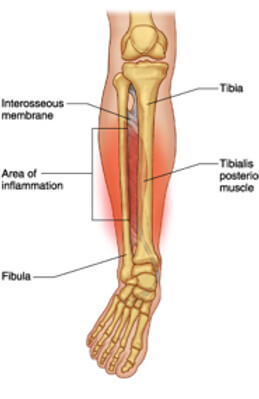
    Shin splints are an overuse bone stress injury affecting the inner (medial) border of your tibia (shin bone).

    What does it feel like?

    • Aching pain along the lower inside shin

    • Sharp pain when running or jumping

    • Tenderness to touch along the bone

    • Morning stiffness or pain when first starting activity

    Unlike a stress fracture (which is more focal and severe), shin splints usually present as a broader area of tenderness along the bone.

    What’s Actually Happening? (The Pathology Explained Simply)

    MTSS is no longer thought to be just an “inflammation” problem.

    Current evidence suggests shin splints develop due to repetitive loading that exceeds the bone’s capacity to adapt. When running loads increase too quickly, the tibia experiences repeated bending stress. If recovery isn’t adequate, this leads to:

    • Bone stress reaction

    • Irritation of the periosteum (bone lining)

    • Localised pain along the medial tibia

    If ignored, MTSS can progress to a tibial stress fracture, which requires significantly longer time away from running.

    That’s why early management matters.

    Why Do Shin Splints Develop?

    A large systematic review by Winkelmann et al. (2016) identified over 100 potential risk factors for MTSS, with several consistently seen in clinical practice.

    Key Risk Factors Supported by Research

    1. Training Load Errors
    Rapid increases in running volume, intensity, or frequency are one of the strongest contributors.
    (Winters et al., 2013; Nielsen et al., 2012)

    2. Higher Body Mass Index (BMI)
    Greater body mass increases tibial loading forces.

    3. Biomechanical Factors

    • Increased navicular drop (foot pronation)

    • Greater plantarflexion range

    • Hip muscle weakness and poor pelvic control

    4. Previous History of MTSS
    Recurrence risk is higher without proper rehabilitation.

    Importantly flat feet alone are rarely the sole cause.

    What we often see clinically is this chain reaction:

    Poor hip control → knee collapses inward → foot over-pronates → increased traction stress on medial tibia.

    The foot is often the victim, not the culprit.

    Why Rest Alone Isn’t Enough

    Yes — rest reduces pain. But rest does not improve:

    • Load tolerance

    • Running capacity

    • Strength deficits

    • Movement control

    This explains why shin splints are common in recreational runners but less frequent in well-structured training programs. Higher-level athletes typically follow progressive loading plans that allow bone and tendon adaptation.

    Research consistently supports graded loading and strengthening as key components of recovery (Moen et al., 2012).

    .

    How to Manage Shin Splints (Early Stage Tips)

    If your symptoms are mild to moderate, here are evidence-informed starting points:

    1️⃣ Relative Rest (Not Complete Rest)

    Reduce running volume by 30–50%.
    Avoid sharp increases in load.
    Swap some runs for cycling or swimming temporarily.

    2️⃣ Strengthen the “Shock Absorbers”

    Focus on:

    • Calf strength (bent and straight knee)

    • Tibialis posterior strengthening

    • Glute medius and hip control exercises

    • Single-leg stability work

    Improving hip strength can reduce tibial loading by improving force control through the limb.

    3️⃣ Manage Running Workload

    Follow the “10% rule” cautiously.
    Allow recovery days between harder sessions.
    Avoid sudden terrain changes (e.g., grass → concrete).

    4️⃣ Consider Footwear

    Ensure shoes are not worn out (>600–800km).
    Orthotics may help some individuals — but only after assessment.

    When Should You See a Physio?

    Seek professional assessment if:

    • Pain persists longer than 2–3 weeks

    • Pain becomes sharp and localised

    • Hopping on one leg is painful

    • Symptoms worsen despite reducing load

    Early intervention reduces the risk of progression to stress fracture.

    How Praxis Approaches Shin Splints

    At Praxis, we don’t treat “shin splints.”
    We treat your specific loading problem.

    Your plan may include:

    ✔ Comprehensive running and strength assessment
    ✔ Individualised load management plan
    ✔ Targeted strength and control program
    ✔ Manual therapy where appropriate
    ✔ Gradual return-to-run progression
    ✔ Prevention strategy for long-term performance

    Because no two runners load the same way, and no two recovery plans should be identical.

    If you’re dealing with shin splints, or want to prevent them from coming back, our team can help.

    Book an in-depth running and lower limb assessment today.

    📍 Clinics in Teneriffe, Buranda & Carseldine
    📞 (07) 3102 3337
    💻 Book online

    💪 Trusted by athletes. Backed by evidence. Here for everyone.

    The Praxis Team.

    PREVENT | PREPARE | PERFORM

    References

    • Winkelmann ZK et al. (2016). Risk factors for medial tibial stress syndrome in active individuals. Journal of Athletic Training, 51(12), 1049–1052.

    • Winters M et al. (2013). Medial tibial stress syndrome: a critical review. Sports Medicine, 43(12), 1315–1333.

    • Moen MH et al. (2012). Treatment of medial tibial stress syndrome: a systematic review. Sports Medicine, 42(11), 965–981.

    • Nielsen RO et al. (2012). Training errors and running-related injuries. International Journal of Sports Physical Therapy, 7(1), 58–75.


    Images:

    The above images are owned by the “Trainer Academy (https://traineracademy.org/) ” and used in this article with thanks.

    References:

    1. Hopper D, Deacon S, Das S, et al. Dynamic soft tissue mobilization increases hamstring flexibility in healthy male subjects. Br J Sports Med. 2004;39:594–598
    2. Weerapong, P., Hume, P.A. & Kolt, G.S. The mechanisms of massage and effects on performance, muscle recovery and injury prevention. Sports Med 2005; 35: 235
    3. Morelli M, Seaborne DE, Sullivan SJ. Changes in h-reflex amplitude during massage of triceps surae in healthy subjects.J Orthop Sports Phys Ther. 1990;12(2):55-9.
    4. Arroyo-Morales M1, Fernández-Lao C, Ariza-García A, Toro-Velasco C, Winters M, Díaz-Rodríguez L, Cantarero-Villanueva I, Huijbregts P, Fernández-De-las-Peñas C. Psychophysiological effects of preperformance massage before isokinetic exercise. J Strength Cond Res. 2011 Feb;25(2):481-8.

    https://www.massagemyotherapy.com.au/Home

    Fact or Fiction – Preseason Training

    Fact or Fiction – Preseason Training

    Answer – FACT

    With preseason training just around the corner, this blog is a timely reminder that turning up to preseason training consistently will give athletes the best chance of being able to play most games next year.

    Murray et al (2017) reported that AFL players who completed <50% of pre-season training were 2x more likely to sustain in-season injury than those who completed >85%! This is not just relevant to elite AFL, it is relevant to all sports of all levels (even more so)! So what’s the take home message? For the best chance to be able to play week in/week out during the competitive phase of the season, consistency during preseason is vital.

    If you had injuries last season or are trying to make this your best season yet, see us to make sure you are ticking all the boxes!

    #praxisphysio #preventprepareperform #factorfictionfriday #preseasontraining #praxispwhatyoupreach #afl #sportsphysio #preventprepareperform

    References:

    Murray NB, et al. Relationship Between Preseason Training Load and In-Season Availability in Elite Australian Football Players. Int J Sports Physiol Perform. 2017.