
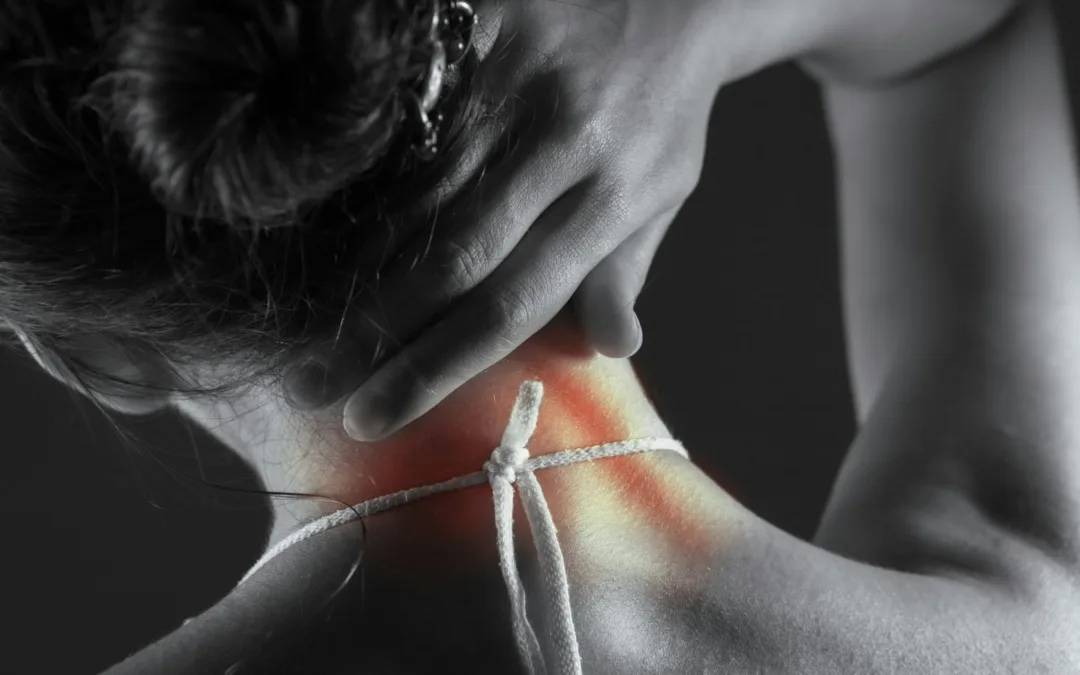
You know the one. It usually starts as a dull ache low down at the base of your skull. Sometimes it wraps around one side of your head. Sometimes it settles behind an eye. It comes on after a long day at the desk, or first thing after a bad night’s sleep. By mid-afternoon you’ve taken two paracetamol and you’re rubbing the back of your neck for the third time. Everyone around you says it’s “just stress” or “too much screen time.” So you shrug, push through, and hope tomorrow is better.
For a lot of people, that headache isn’t coming from your brain at all, it’s coming from your neck. It’s called a cervicogenic headache. It behaves differently to a migraine or a classic tension headache, which is exactly why it so often gets missed, mislabelled, or treated with the wrong thing for years.
The good news is that unlike some headache types, cervicogenic headache responds very well to the right kind of physiotherapy. It just needs to be recognised for what it is first.
WHAT MAKES A HEADACHE “CERVICOGENIC”?
Cervicogenic headache is caused by a problem in the neck, not in the head itself. Usually it’s the upper three cervical joints, discs, or the muscles and ligaments around them. The diagnostic criteria were first proposed by the Cervicogenic Headache International Study Group. They describe a headache that’s typically one-sided, starts in the neck or back of the head, and spreads forward. It’s also triggered or aggravated by particular neck movements, sustained postures, or pressure on specific spots in the upper neck (Sjaastad, Fredriksen & Pfaffenrath, 1998). The current international headache classification (ICHD-3) recognises it as a distinct secondary headache disorder for this reason (Headache Classification Committee of the IHS, 2018).
It’s more common than most people realise. Population studies estimate that somewhere between 1 and 4% of adults live with cervicogenic headache at any given time. It disproportionately affects people in their 30s to 50s, often those in desk-based or repetitive-posture jobs (Sjaastad & Bakketeig, 2008).
HOW IS IT DIFFERENT FROM MIGRAINE OR TENSION HEADACHE?
This is where things get tricky, because cervicogenic headache can look a lot like both. A few clues point toward the neck as the source. The pain is consistently on the same side. It’s brought on or reproduced by turning or tilting your head, by pressing into the muscles at the top of your neck, or by holding your neck in one position too long, like scrolling on your phone or driving. Range of movement in the neck is usually reduced (ICHD-3; Sjaastad et al., 1998).
Migraine, by contrast, tends to be more variable in location. It’s often accompanied by more prominent nausea, light and sound sensitivity, and visual disturbance, and isn’t reliably triggered by neck movement. Tension-type headache is usually a more generalised, band-like pressure. It doesn’t have a clear point of origin at the back of the skull. The overlap in symptoms is real. That’s why cervicogenic headache is frequently misdiagnosed as one of the other two. It’s a mistake that can mean months or years of treating the wrong problem.
WHAT’S ACTUALLY GOING WRONG IN THE NECK?
Research led by physiotherapist Gwendolen Jull and colleagues has repeatedly found a consistent pattern in people with cervicogenic headache (Jull, Barrett, Magee & Ho, 1999). The deep neck flexor muscles, the small stabilising muscles at the front of the neck, are weak and slow to activate. The superficial neck and upper trapezius muscles are overactive and tight. Movement in the upper cervical joints is restricted, and the upper neck segments are tender. In plain terms, three things happen. The deep, supportive muscles that are supposed to hold your upper neck steady switch off. The bigger surface muscles take over and get overworked and tight. And the joints at the top of the neck lose their normal movement. That combination of a stiff joint and an under-supported muscle system is what keeps referring pain up into the head.
BUSTING THE MYTH: “IT’S JUST STRESS, THERE’S NOTHING I CAN DO BUT TAKE PAINKILLERS”
This is the line we hear constantly, and it’s simply not supported by the evidence. Stress and screen posture can certainly aggravate cervicogenic headache. But the underlying driver is a measurable, treatable problem in the joints and muscles of the upper neck, not a vague, untreatable “tension” that only pills can dull. Painkillers might take the edge off an individual flare-up. But they do nothing to correct the joint stiffness or muscle imbalance causing the headaches to keep coming back. The research on targeted physiotherapy tells a very different, more hopeful story.
WHAT ACTUALLY WORKS
The strongest evidence for cervicogenic headache is a combination of manual therapy (hands-on mobilisation of the stiff upper cervical joints) and a specific, low-load strengthening program for the deep neck flexors and postural muscles. In a landmark randomised controlled trial, Jull and colleagues found that manipulative therapy and specific low-load exercise each significantly reduced headache frequency and intensity, with benefits still present at 12 months (Jull et al., 2002). The best results came from combining the two. A more recent systematic review and meta-analysis, pooling multiple trials, confirmed moderate-to-large effects of manual and exercise therapy on headache frequency and intensity in the short term. Benefits persisted into the longer term (Bini, Hohenschurz-Schmidt, Masullo, Pitt & Draper-Rodi, 2022).
In the clinic, this typically looks like joint mobilisation of the upper neck and retraining of the deep neck flexors using graded craniocervical flexion exercises. It also includes release work for the overactive superficial and upper trapezius muscles, plus postural and workstation retraining. If you’ve already read our post on neck pain and what to do about it, a lot of the same joint and muscle principles apply here. Cervicogenic headache is really neck pain wearing a different hat. Remedial massage can also play a useful supporting role in easing the overworked superficial muscles alongside your rehab program. See our post on the benefits of remedial massage for more on that. If you want a demonstration of the kind of deep neck strengthening we’re talking about, check out our YouTube video “Deep and Superficial Cervical Loading on Pilates Ball || Supine Neck Strengthening Progressions” on our channel, @praxisphysiotherapy. It walks through exactly the muscle retraining that’s often underactive in people with neck pain or headaches.
THE TAKEAWAY
If your headaches start at the base of your skull, sit on one side, and seem to flare with neck movement or a long day hunched over a screen, there’s a good chance your neck is the actual source. It’s not just stress. And unlike some headache types, this one has strong, specific evidence behind it. Targeted manual therapy plus deep neck muscle retraining can meaningfully reduce how often these headaches show up and how much they hurt, with effects that last.
If that sounds familiar, don’t just keep reaching for the painkillers. Come and see us at Praxis Physiotherapy in Teneriffe, Woolloongabba, or Carseldine. We’ll assess your neck properly, confirm whether it’s driving your headaches, and build you a plan based on the evidence above.
Until next time, Praxis What You Preach…
📍 Clinics in Teneriffe, Woolloongabba, and Carseldine
💪 Trusted by athletes. Backed by evidence. Here for everyone.
Related Articles
Rotator Cuff Repair: A Physiotherapy Guide on Recovery and Rehabilitation
Shoulder Stabilisation and Bankart Repair: Your Path Back to Sport

Why Tennis Elbow Takes So Long to Get Better (And What Actually Works)
References
Bini P, Hohenschurz-Schmidt D, Masullo V, Pitt D, Draper-Rodi J. The effectiveness of manual and exercise therapy on headache intensity and frequency among patients with cervicogenic headache: a systematic review and meta-analysis. Chiropractic & Manual Therapies. 2022;30:50.
Headache Classification Committee of the International Headache Society (IHS). The International Classification of Headache Disorders, 3rd edition. Cephalalgia. 2018;38(1):1-211.
Jull G, Barrett C, Magee R, Ho P. Further clinical clarification of the muscle dysfunction in cervical headache. Cephalalgia. 1999;19(3):179-185.
Jull G, Trott P, Potter H, et al. A randomized controlled trial of exercise and manipulative therapy for cervicogenic headache. Spine. 2002;27(17):1835-1843.
Sjaastad O, Bakketeig LS. Prevalence of cervicogenic headache: Vågå study of headache epidemiology. Acta Neurologica Scandinavica. 2008;117(3):173-180.
Sjaastad O, Fredriksen TA, Pfaffenrath V. Cervicogenic headache: diagnostic criteria. The Cervicogenic Headache International Study Group. Headache. 1998;38(6):442-445.